
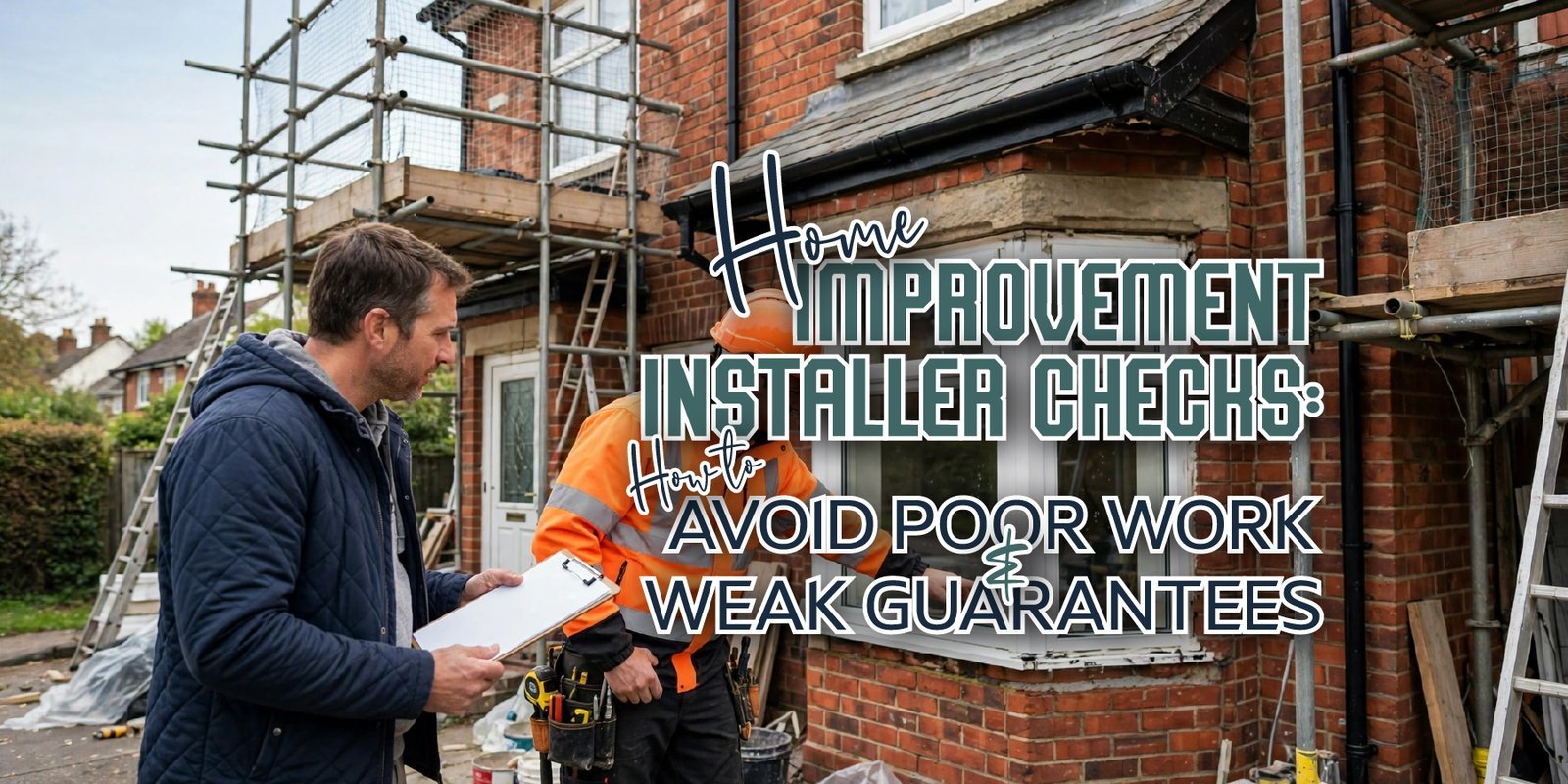
Choosing someone for a home improvement project involves more than finding an attractive quotation. The installer you select can affect the project’s scope, materials, workmanship, timescale, communication and aftercare.
However, comparing tradespeople can be difficult when quotations use different descriptions or leave important details unclear. One installer may include preparation and finishing, while another may price those tasks separately.
Therefore, a sensible home improvement comparison starts with the complete project rather than the headline figure. Before agreeing to work, review the quotation, relevant experience, payment arrangements, warranty information, exclusions and process for handling changes.
The aim is not to identify a universally “best” installer. Instead, this guide provides a practical framework for comparing information and making a more informed decision.
What Should You Check Before Hiring a Home Improvement Installer?
Before hiring a home improvement installer, review their relevant experience, written quotation, project scope, materials, expected timescale, warranty information, payment terms, exclusions and previous work where available. You should also clarify relevant insurance or trade credentials where appropriate and ask how additional work will be handled.
A useful initial checklist includes:
- Relevant project experience
- Previous work or references where available
- Detailed written quotation
- Clear project scope
- Materials and products
- Labour arrangements
- Expected timescale
- Payment schedule
- Warranty information
- Exclusions
- Variation process
- Aftercare arrangements
Most importantly, ask questions about anything you cannot understand from the written information.
How to Check Home Improvement Installers
When comparing home improvement installers, start by considering whether their previous work is relevant to your project. Someone who regularly handles a particular type of refurbishment may be more familiar with its practical requirements, although previous experience alone should not determine your decision.
For example, a bathroom refurbishment, insulation project, window replacement and heating upgrade can involve very different skills and installation requirements.
Check the following areas:
Relevant experience
Ask whether the installer has completed projects similar in type and scope to yours. Where previous examples are available, look at whether the work resembles the standard and finish you are seeking.
Written quotations
A written quotation provides something concrete to compare. It should explain the proposed work clearly enough for you to identify what is included and what remains your responsibility.
Communication
Good communication does not guarantee good workmanship. Nevertheless, clear answers can make it easier to understand the project and resolve questions before work starts.
Qualifications and insurance
Some projects may involve specialist trades or regulated work. Where qualifications, registrations or insurance are relevant, ask the installer what applies to the proposed work and request appropriate documentation.
Previous work
Where references, photographs or previous projects are available, use them to understand the installer’s experience. However, treat these as one part of your overall assessment.
Warranty and aftercare
Ask what warranty arrangements apply to the installation and whether manufacturers provide separate product coverage.
What Makes a Good Renovation Quote?
A useful quotation should describe the proposed work, labour, materials, products, preparation, removal, finishing, timescale, payment arrangements, exclusions and potential additional costs. The more clearly a quotation defines the project, the easier it becomes to compare it with another proposal on a like-for-like basis.
A detailed home improvement quotation may include:
- Description of work
- Labour
- Materials
- Product specifications
- Quantities where relevant
- Preparation
- Removal
- Waste disposal
- Finishing
- Project timescale
- Payment schedule
- Exclusions
- Potential additional costs
- Total price
However, not every quotation will use the same format. Therefore, ask the installer to clarify unfamiliar terms or items that appear incomplete.
A quotation that simply states “full refurbishment” may require further explanation. Ask what the phrase actually covers.
How to Compare Renovation Quotes Without Focusing Only on Price
Comparing renovation quotes works best when you first compare their scope. A lower total may reflect fewer included tasks, different materials or a different approach to preparation.
Use this framework:
| Factor | What to Check |
|---|---|
| Scope | Is the same work included? |
| Labour | Are all required trades covered? |
| Materials | Are products and quantities specified? |
| Preparation | Is preparation work included? |
| Removal | Is existing material or equipment removal included? |
| Waste | Who handles disposal? |
| Timescale | Is an estimated schedule provided? |
| Payment | What are the payment stages? |
| Warranty | What does the installer provide? |
| Exclusions | What is not included? |
| Variations | How are additional works handled? |
| Total | Are the quotations genuinely comparable? |
For instance, one quotation may include painting and finishing while another stops after installation. Consequently, the totals cannot be compared fairly without accounting for the difference.
Installer Warranty: What Should Homeowners Check?
An installer warranty should be assessed by reading the actual written terms rather than relying on a verbal description. Check what the warranty covers, what it excludes, how long it applies, who is responsible for claims and whether different products have separate manufacturer coverage.
Ask about:
- What work is covered
- What products are covered
- Warranty duration
- When coverage begins
- Labour coverage
- Material coverage
- Exclusions
- Defect reporting
- Claim procedures
- Manufacturer warranties
- Documentation
- Aftercare
Warranty terms can vary considerably between projects and installers. Therefore, do not assume that every home improvement project carries the same protection.
Equally, a longer warranty does not automatically prove better workmanship. Read the conditions and understand what the installer actually promises.
Warranty vs Guarantee: What Is the Difference?
The words “warranty” and “guarantee” can appear in quotations and marketing material, but their exact meaning and contractual effect depend on the relevant agreement, product and circumstances.
Rather than relying on terminology alone, review the actual written terms.
Check:
- What is covered?
- What is excluded?
- Who provides the coverage?
- How long does it apply?
- How do you report an issue?
- Are labour and products treated separately?
- Does manufacturer coverage apply?
- What documentation do you receive?
If you are unsure about the legal effect of a particular term, consider obtaining appropriate independent advice rather than assuming what it means.
How to Check an Installer’s Previous Work
Previous work can help you understand whether an installer has experience with projects similar to yours. However, homeowners should consider relevance rather than simply counting the number of completed projects.
Where available, review:
- Similar project types
- Before-and-after photographs
- Completed installations
- References
- Project scope
- Finishing quality
- Materials used
- Complexity of previous work
For example, someone planning a major home improvement project may benefit from seeing examples involving a similar level of preparation and installation.
Ask whether photographs represent the installer’s own work and whether the examples are comparable to your proposed project. Avoid treating photographs alone as proof of future performance.
Questions to Ask Home Improvement Installers
Before agreeing to a home improvement project, ask practical questions that reveal the proposed scope.
- Have you completed similar projects?
- What exactly does your quotation include?
- Which materials are included?
- Which materials do I need to supply?
- Which trades are involved?
- What preparation work is required?
- What is excluded?
- What timescale do you expect?
- How will changes to the project be priced?
- What payment schedule applies?
- What warranty terms do you provide?
- Are manufacturer warranties separate?
- What happens if additional work becomes necessary?
- What aftercare do you provide?
- Which documents will I receive?
Additionally, ask questions that relate specifically to your property. The right questions can differ depending on whether you are arranging a bathroom, heating, insulation, window or wider refurbishment project.
Comparing Your Home Improvement Options
Before selecting an installer, it can help to define exactly what you want the project to achieve. Compare the scope, materials, labour requirements, expected timescale and warranty information before focusing on individual quotations.
For homeowners who are exploring different project possibilities, compare home improvement options can provide a useful starting point for considering available quotation opportunities.
The comparison process should remain focused on your actual requirements. Therefore, clarify the project first and then assess how each proposed solution addresses those requirements.
Warning Signs to Look for in an Installer Quote
Some quotation characteristics deserve clarification. They do not automatically mean that an installer is unsuitable, but they can make a proposal harder to assess.
Ask questions when a quotation:
- Gives only a single total figure
- Contains very little detail
- Does not explain materials
- Does not state exclusions
- Does not explain payment stages
- Leaves major work unspecified
- Provides unclear timescales
- Does not explain warranty terms
- Uses unclear allowances
- Does not explain how additional work will be priced
For example, if a quotation includes “materials” without specifying what those materials are, ask for greater detail.
Similarly, if a quotation states that additional work may incur extra charges, ask how those charges will be agreed before the work proceeds.
Before Paying a Deposit
A deposit can form part of a home improvement agreement, but homeowners should understand the payment arrangements before transferring money.
Check:
- Written quotation
- Project scope
- Payment schedule
- Deposit amount
- Expected start date
- Proposed project sequence
- Materials
- Contract or written agreement
- Cancellation terms where applicable
- Warranty information
- Installer contact details
Do not assume that a deposit means the entire project has been formally agreed. Review the relevant documentation and make sure you understand what the payment relates to.
Also ask what happens if the project changes or work cannot begin on the expected date.
How to Compare Installer Warranties and Guarantees
The written terms matter more than the headline promise. Compare what each installer actually agrees to cover.
| Check | Installer A | Installer B | What to Compare |
|---|---|---|---|
| Warranty duration | Length and start date | ||
| Labour coverage | What work is covered? | ||
| Materials | Installer or manufacturer coverage | ||
| Exclusions | What is not covered? | ||
| Reporting process | How are issues reported? | ||
| Documentation | Is it provided in writing? | ||
| Aftercare | What support is available? |
Keep copies of the quotation, agreement, warranty information, invoices and relevant product documentation.
Furthermore, check whether separate manufacturer warranties apply to specific products. These may operate independently from an installer’s own terms.
Energy-Efficiency Home Improvements and Installer Checks
Installer checks also matter when arranging energy-related work. Insulation, efficient heating, windows and other energy-saving upgrades can involve different products, installation methods and property considerations.
When comparing an energy-related home improvement, ask how the installer has assessed the property and what the quotation includes.
Our guide to home improvement for energy efficiency provides further context on comparing energy-efficiency upgrade options.
The same principle applies here: understand the proposed work before comparing the final price.
Comparing Heating Upgrade Installers
Heating projects can require additional checks because equipment selection, property suitability and installation scope can vary.
When comparing a heating installer, ask about:
- Proposed equipment
- Property assessment
- Installation scope
- Controls
- Supporting components
- Warranty information
- Maintenance requirements
- Exclusions
- Additional work
For example, homeowners considering renewable heating can review heat pump quotes to understand the information that can matter when comparing heating proposals.
Keep the same approach throughout your home improvement planning: compare the complete project scope rather than the headline figure alone.
Common Home Improvement Installer Mistakes Homeowners Make
Homeowners can make the comparison process harder by focusing too narrowly on price.
Common mistakes include:
1. Choosing purely on price
The cheapest quotation may not cover the same work as another proposal.
2. Comparing different project scopes
Check whether every quotation includes the same major tasks.
3. Accepting a verbal quotation
A written quotation provides clearer information to review and compare.
4. Not checking exclusions
Items outside the quotation can affect the eventual project cost.
5. Ignoring warranty terms
Ask what the warranty covers and request the terms in writing.
6. Not asking who supplies materials
Clarify whether you or the installer purchases products.
7. Not discussing payment stages
Understand when payments are expected and what each stage relates to.
8. Failing to clarify the project schedule
Ask when work is expected to start and how the project is expected to progress.
9. Not asking how variations are handled
Find out how changes or additional work will be discussed and priced.
10. Not keeping documentation
Keep quotations, agreements, invoices, warranties and relevant correspondence together.
A Home Improvement Installer Checklist
Use this checklist before agreeing to a home improvement project:
- ☐ Relevant project experience checked
- ☐ Written quotation received
- ☐ Scope of work understood
- ☐ Labour identified
- ☐ Materials identified
- ☐ Exclusions identified
- ☐ Timescale discussed
- ☐ Payment terms understood
- ☐ Warranty terms reviewed
- ☐ Manufacturer warranty checked where relevant
- ☐ Previous work reviewed where available
- ☐ Contract or written agreement reviewed
- ☐ Additional-work process understood
- ☐ Contact details confirmed
- ☐ Relevant project documentation retained
This checklist does not replace professional or legal advice. Instead, it gives homeowners a practical structure for asking questions before work begins.
How Should You Compare Home Improvement Installers?
Compare home improvement installers by reviewing their relevant experience, project scope, written quotation, materials, labour, timescale, warranty terms, exclusions, payment arrangements and aftercare. Consider previous work where available, and ask questions whenever important details remain unclear.
A useful comparison looks beyond the final figure. Therefore, assess what each installer proposes to deliver and how clearly they explain the project.
What Should a Renovation Quote Include?
A renovation quote should explain the proposed work, labour, materials, preparation, removal, finishing, timescale, payment arrangements and exclusions. Where relevant, it should also identify products, quantities, waste disposal and the process for handling additional work.
The exact format varies, so ask the installer to clarify anything that could materially affect the scope or final cost.
What Should I Look for in Home Improvement Installers?
Look for relevant experience, clear communication, detailed quotations, appropriate documentation, understandable project terms and written warranty information. Where relevant, check qualifications, insurance or other credentials that apply to the specific work.
No single factor proves that an installer is suitable. Instead, consider the complete information alongside your own project requirements.
What Does an Installer Warranty Normally Cover?
An installer warranty can cover specified workmanship or installation-related issues, but the exact coverage depends on the written terms. Check the duration, exclusions, claim process, labour coverage and any separate manufacturer warranties.
Never assume that every installer offers identical protection. Review the actual documentation and ask questions before agreeing to the project.
How Should I Compare Renovation Quotes?
Compare renovation quotes by checking whether they cover the same work. Review labour, materials, preparation, removal, waste disposal, timescale, payment terms, warranties, exclusions and potential additional costs.
If one quote contains less detail, ask the installer to clarify the scope before comparing the total against another proposal.
What Questions Should I Ask a Tradesperson Before Work Starts?
Ask what the quotation includes, which materials are covered, which trades are involved, what preparation is required, what is excluded, how long the work is expected to take and how additional work will be priced.
Also ask about payment arrangements, warranties, aftercare and the documents you will receive. Keep important answers in writing where appropriate.
Should I Compare Installer Warranties Before Choosing a Quote?
Yes, warranty terms form part of the overall project information. Compare what each installer covers, the duration, exclusions, reporting process, labour coverage and any separate manufacturer warranties.
However, do not judge an installer solely by warranty length. A broader assessment should include project scope, experience, quotation detail, materials, timescale and other contractual terms.
What Should I Check Before Paying a Deposit for Home Improvement Work?
Before paying a deposit, review the written quotation, project scope, payment schedule, expected start date, materials, warranty information and relevant agreement. Also clarify how cancellations, delays or additional work are handled where applicable.
Make sure you understand what the deposit relates to and retain evidence of the agreement and payment.
Compare Your Home Improvement Options
Choosing an installer is an important part of planning a home improvement project, but the comparison should begin before you focus on the final price.
First, define what you need. Then compare the project scope, labour, materials, timescale, payment terms, exclusions and warranty information offered by different installers.
You can compare available home improvement options as part of your initial project planning.
Ultimately, the strongest comparison is one where you understand what each quotation covers and what responsibilities remain with you. Keep the relevant documentation, ask questions before work starts and make sure important terms are clear in writing.
How do I check a home improvement installer?
Check whether the installer has relevant experience, provides a clear written quotation and explains the project scope, materials, timescale, payment arrangements and warranty terms. Where appropriate, ask about relevant qualifications or insurance and review previous work or references where available. Consider the complete information rather than relying on one factor.
What should a renovation quote include?
A renovation quote should clearly describe the proposed work, labour, materials, preparation, removal, finishing, timescale, payment arrangements and exclusions. Depending on the project, it may also identify products, quantities, waste disposal and how additional work will be handled. Ask for clarification whenever important parts of the scope remain unclear.
What should I look for in home improvement installers?
Look for relevant project experience, clear communication, detailed quotations, understandable payment terms, written warranty information and a clearly defined project scope. Where relevant, check applicable qualifications or insurance. Previous work can also provide useful context. However, no single factor proves that an installer is suitable for every project.
What does an installer warranty normally cover?
An installer warranty may cover specified installation or workmanship issues, but the exact terms depend on the agreement. Check the duration, exclusions, claim process, labour coverage and whether products have separate manufacturer warranties. Always review the written terms instead of assuming that a warranty provides the same protection across different installers.
How should I compare renovation quotes?
Compare renovation quotes on a like-for-like basis. Review the scope, labour, materials, preparation, removal, waste disposal, timescale, payment terms, warranty information, exclusions and potential additional costs. If two quotations cover different work, ask the installers to clarify the differences before comparing their total figures.
What questions should I ask a tradesperson before work starts?
Ask what work is included, which materials are covered, which trades are involved, what preparation is required, what is excluded and what timescale is expected. Also ask how additional work will be priced, what payment stages apply, what warranty terms are available and which documents you will receive.
Should I compare installer warranties before choosing a quote?
Yes. Warranty information forms part of the overall quotation comparison. Check what each installer covers, how long the coverage lasts, what exclusions apply, how claims are reported and whether manufacturers provide separate product warranties. However, warranty length should not be considered in isolation from project scope, workmanship information and other contractual terms.
What should I check before paying a deposit for home improvement work?
Before paying a deposit, review the written quotation, project scope, payment schedule, expected start date, materials, warranty terms and relevant agreement. Clarify how additional work or changes will be handled. You should also understand what the deposit relates to and retain documentation showing the agreed terms and payment.
Compare Your Home Improvement Options
Before choosing an installer, define the requirements of your home improvement project. Consider the work involved, materials, labour, expected timescale, payment arrangements, warranty information and any exclusions.
Once the scope is clear, you can compare home improvement options and explore quotation opportunities.
A clear project brief makes it easier to ask installers consistent questions and compare their proposals on a like-for-like basis. It also helps you identify important differences before agreeing to the work.