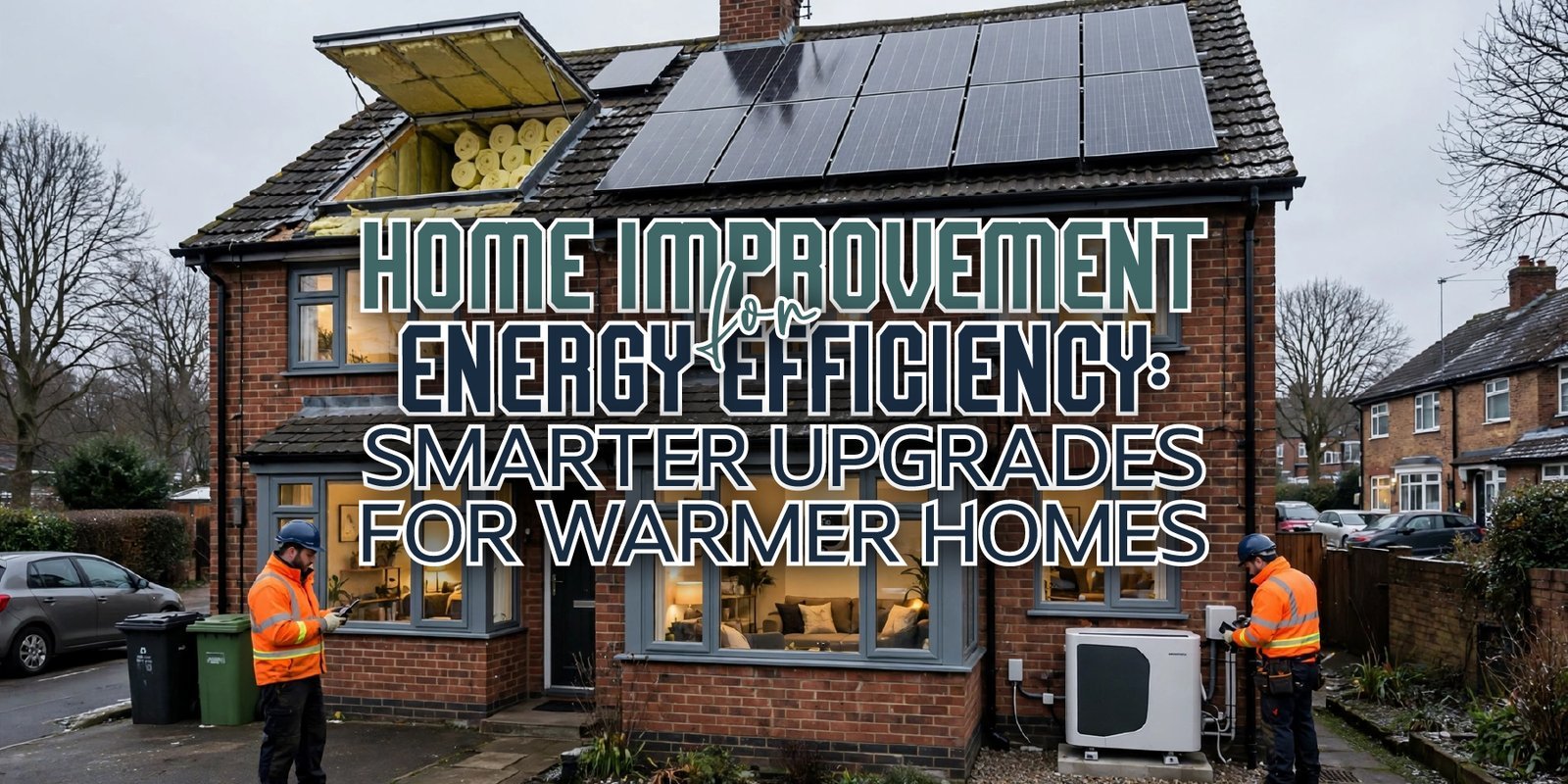
Making a home warmer and more energy efficient often requires more than replacing one component. A well-planned home improvement strategy can consider insulation, heating, windows, draught reduction, ventilation and the existing condition of the property together.
However, every property has different characteristics. Therefore, the right home improvement priorities depend on the building, its current heating system, insulation levels, windows, construction and the way the household uses energy.
Rather than choosing the most popular upgrade, homeowners should first understand where their property may be losing heat and which improvements could address those issues.
What Home Improvement Upgrades Can Improve Energy Efficiency?
Several types of home improvement can contribute to better energy efficiency, including insulation improvements, efficient heating, suitable window upgrades, draught reduction and ventilation improvements. The appropriate combination depends on the property’s condition, construction, existing systems, installation requirements and household needs.
For example, improving insulation may address a different issue from replacing an older heating system. Similarly, new windows may be useful where existing frames or glazing contribute to unwanted heat loss, but they will not necessarily address every energy-efficiency issue.
Consequently, homeowners should consider the property as a whole before deciding which upgrade to prioritise.
Start With a Home Energy-Efficiency Assessment
A sensible home improvement process starts with understanding what already exists. Before requesting quotations, review the property’s insulation, windows, heating system, ventilation, draughts and general condition.
Consider:
- Property age
- Construction type
- Existing insulation
- Window condition
- Heating system
- Heating controls
- Signs of heat loss
- Draughts
- Ventilation
- Current energy use
- Previous alterations
Older properties may have undergone several alterations over time. As a result, two homes of a similar age can have very different requirements.
A useful first step is to identify the most noticeable problems rather than immediately selecting a particular product. For instance, rooms that feel consistently colder, visible draughts or uneven heating may indicate areas worth investigating.
This approach can make home improvement planning more focused. It also gives homeowners better questions to ask when comparing professional recommendations.
Insulation Improvements: A Key Part of Energy-Efficient Home Improvement
Insulation improvements can form an important part of an energy-efficiency strategy because insulation affects how readily heat moves through parts of a building.
Potential areas include:
- Loft insulation
- Cavity wall insulation where appropriate
- Solid wall considerations
- Floor insulation where appropriate
- Roof-related heat loss
- Draught reduction
- Areas affected by thermal bridging
However, insulation requirements vary between properties. Building construction, existing materials, moisture conditions and previous work can all influence what is appropriate.
For example, a solution suitable for one type of wall construction may not suit another. Therefore, homeowners should avoid assuming that every property requires the same insulation approach.
A professional assessment can help identify existing insulation and areas where heat loss may warrant further investigation. Additionally, homeowners should consider the condition of the building before committing to significant work.
Good home improvement planning therefore considers insulation alongside ventilation and moisture management rather than treating each issue independently.
Efficient Heating: When Should You Consider an Upgrade?
Efficient heating should be considered alongside the condition of the property. If a building has significant heat-loss issues, changing the heating system without understanding those issues may not provide the complete solution a homeowner expects.
Review:
- Existing boiler or heating system
- System condition
- Heating controls
- Radiators
- Heat distribution
- Insulation
- Property construction
- Household heating requirements
Different heating technologies suit different circumstances. For example, heat pumps may form part of a wider heating strategy for some properties, while other homes may require a different approach.
The key point is suitability. No single heating technology is automatically the right choice for every property.
Therefore, a home improvement plan should consider the building fabric and heating system together. Ask providers to explain how their recommendation relates to the property’s characteristics rather than relying on a generic solution.
Window Upgrades: What Should Homeowners Check?
Window upgrades can form part of a wider energy-efficiency strategy, particularly where existing windows have poor condition, noticeable draughts or outdated glazing.
Before deciding on replacement, examine:
- Existing glazing
- Frame condition
- Draughts
- Opening mechanisms
- Installation quality
- Ventilation
- Property character
- Applicable planning or building requirements
Replacing windows is not automatically necessary simply because a property is older. In some cases, existing windows may remain appropriate, while in others replacement may form part of a broader refurbishment.
Property character also matters. Certain homes may have architectural features that homeowners want to retain. Consequently, aesthetic, practical and energy considerations should all form part of the decision.
A well-considered home improvement strategy looks beyond the window itself and considers how replacement interacts with ventilation, insulation and the wider building.
Which Energy-Saving Upgrades Should You Prioritise?
The right home improvement priority depends on the property, so there is no universal upgrade order. A practical approach starts by understanding the building, identifying likely heat-loss areas and then comparing suitable options.
A useful framework is:
- Understand the current property condition.
- Identify significant sources of heat loss.
- Review existing insulation.
- Assess the current heating system.
- Consider windows and draught reduction.
- Review ventilation and moisture management.
- Compare project scope and practical disruption.
- Prioritise improvements according to the property’s needs.
However, this sequence should not be treated as a fixed rule. A professional assessment may change the order.
For example, a property with inadequate insulation may require a different starting point from one where insulation is already established but the heating system needs attention.
Ultimately, effective home improvement planning means solving the property’s actual problems rather than following a standard checklist without considering context.
Compare Home Improvement Options Before You Commit
Homeowners considering several upgrades should compare more than the initial quotation. Look at project scope, installation requirements, property suitability, disruption, materials and the work that each provider includes.
For example, one proposal might cover preparation work that another excludes. Similarly, different approaches may require different levels of property alteration.
You can compare home improvement options when reviewing possible upgrade routes.
The purpose of comparison is not simply to find the lowest figure. Instead, consider whether each option addresses the same requirement and whether the proposed scope matches your property’s needs.
Home Improvement Costs: How to Think About Your Budget
Cost is an important part of any home improvement decision, but a headline figure rarely tells the whole story.
Depending on the project, homeowners may need to consider:
- Materials
- Labour
- Preparation work
- Installation
- Removal of existing materials
- Access requirements
- Electrical work
- Plumbing
- Structural considerations
- Professional assessment
- Follow-on work
- Maintenance requirements
The final cost can vary substantially according to the property’s condition, project scope, materials, labour and installation requirements.
Therefore, homeowners should compare the complete scope rather than assuming that the cheapest initial quotation represents the lowest overall cost.
The home improvement costs resource can provide a useful reference when considering the financial side of different projects.
When reviewing quotations, ask providers to identify exclusions and potential additional work. This makes comparisons more meaningful and can help reveal where two proposals differ.
Should You Combine Several Home Improvements?
Combining projects can sometimes make practical sense, particularly when different upgrades involve overlapping preparation, access or trades. However, homeowners do not need to complete every possible improvement at once.
Consider:
- Project sequencing
- Shared preparation work
- Access
- Disruption
- Budget
- Contractor coordination
- Dependencies between projects
For example, work affecting walls, floors or ceilings may influence the order of other improvements. Similarly, plumbing or electrical work can interact with room renovations.
The key is coordination rather than unnecessary spending. A sensible home improvement programme should reflect the homeowner’s priorities, budget and property requirements.
Before combining several projects, ask whether doing so genuinely creates a practical advantage. If not, completing the improvements separately may be more appropriate.
Home Improvement Planning for Older Properties
Older homes often require a more tailored home improvement approach because construction methods, previous alterations and existing materials can vary considerably.
Review:
- Property age
- Construction
- Previous alterations
- Existing insulation
- Windows
- Heating
- Ventilation
- Damp or moisture concerns
- General building condition
An older property does not automatically require extensive upgrades. Instead, homeowners should establish what the building already has and where genuine issues exist.
For instance, previous owners may have already upgraded insulation, windows or heating. Checking the current condition first can prevent unnecessary duplication.
Furthermore, property character can influence decisions. Homeowners may need to balance energy-efficiency goals with appearance, materials and planning considerations where relevant.
A thoughtful home improvement plan therefore starts with the actual property rather than assumptions based solely on its age.
How to Make a Home Warmer Without Choosing the Wrong Upgrade
The most useful home improvement decision starts with the problem rather than the product.
Use this framework:
1. Identify the problem
Determine whether the main concern involves draughts, heat loss, uneven heating, poor insulation, windows or another issue.
2. Understand the property
Consider construction, existing systems, previous upgrades and current condition.
3. Identify heat-loss areas
Look at insulation, windows, doors, roof areas and other relevant parts of the building.
4. Consider suitable options
Compare insulation, heating, windows, draught reduction and ventilation improvements according to the property.
5. Assess installation requirements
Think about access, preparation, disruption and any additional work.
6. Compare the complete project scope
Review what each quotation includes and excludes.
7. Plan the sequence
If multiple improvements are required, consider whether one project needs to happen before another.
This process does not guarantee a particular outcome. Instead, it provides a structured way to approach home improvement decisions without selecting an upgrade simply because it is currently popular.
Home Improvement Checklist for Energy Efficiency
Use this checklist when planning an energy-efficiency home improvement project:
- Assess current property condition
- Review insulation
- Check windows
- Review the heating system
- Consider heating controls
- Check for draughts
- Review ventilation
- Identify major heat-loss areas
- Consider project sequencing
- Set a realistic budget
- Compare quotations
- Check what each quotation includes
- Consider installation disruption
- Check whether additional work may be required
- Prioritise upgrades according to the property
Keep a written record of your findings. Additionally, note questions for installers or other professionals before requesting quotations.
This can make it easier to compare proposals because you are asking providers to address broadly similar requirements.
Common Home Improvement Mistakes
1. Choosing upgrades before assessing the property
A popular solution may not address the main issue in your home. Start with the property’s condition instead.
2. Focusing only on headline price
A low initial figure may cover a different scope from a more detailed proposal. Compare inclusions and exclusions.
3. Ignoring insulation
Heating efficiency and building performance are connected. Review insulation before making major heating decisions.
4. Replacing heating without considering the building
The heating system does not operate independently from the property. Consider insulation, heat loss and heat distribution together.
5. Assuming new windows solve every heat-loss issue
Windows are only one part of the building envelope. Draughts, insulation and ventilation may also require attention.
6. Ignoring ventilation
Reducing unwanted heat loss should not mean overlooking moisture and airflow. Consider ventilation as part of the wider project.
7. Comparing quotes with different scopes
Two quotations cannot provide a meaningful comparison if they cover substantially different work.
8. Forgetting preparation work
Removal, access, surface preparation and other preliminary tasks can affect project scope.
9. Trying to complete every upgrade simultaneously
A large programme can create significant disruption and financial pressure. Prioritise according to actual requirements.
10. Choosing an upgrade because it is popular
A solution that works well in one property may not suit another. Always consider the building itself.
Energy Efficiency and Wider Home Renovation
Energy-efficiency projects can overlap with broader renovation work. Therefore, homeowners carrying out several projects may want to consider how plumbing, heating, ventilation, electrical work, flooring and room upgrades interact.
For example, someone already planning a bathroom renovation may also be reviewing heating or ventilation requirements.
However, the connection should be practical rather than an excuse to expand the project unnecessarily. Coordinate work where there is a genuine reason to do so, while keeping separate projects separate when that makes more sense.
This type of planning can help homeowners establish which work needs to happen first and which improvements can wait.
What Is the Best Home Improvement for Energy Efficiency?
There is no single home improvement that is universally best for every property. The appropriate priority depends on the building’s construction, insulation, windows, heating system, ventilation, condition and sources of heat loss.
For one property, insulation may deserve closer attention. For another, heating or window condition may be more relevant.
Therefore, homeowners should assess the property first and then compare suitable solutions rather than selecting an upgrade solely because it is widely promoted.
Should I Improve Insulation Before Replacing Heating?
Insulation and heating should be considered together, but the correct sequence depends on the property. If significant heat-loss issues exist, addressing them may influence how the heating system needs to perform.
However, every property is different. A professional assessment can help establish whether insulation work should precede, accompany or follow a heating upgrade.
The important point is to avoid treating the heating system and building fabric as completely separate decisions.
Do Window Upgrades Improve Energy Efficiency?
Window upgrades can contribute to improved energy performance where existing glazing, frames or draughts create relevant issues. However, the potential benefit depends on the current windows, property construction, installation quality and other sources of heat loss.
Homeowners should therefore assess the existing windows before deciding on replacement. Consider the condition, glazing, frames, ventilation and property character together.
How Should I Choose Energy-Saving Upgrades?
Start by assessing the property’s current condition. Next, identify significant heat-loss areas, review insulation and heating, consider windows and ventilation, and then compare suitable project options.
Finally, compare the complete installation scope and cost rather than choosing solely on headline price. This structured approach helps homeowners make home improvement decisions that relate to their property’s actual needs.
Comparison Table
| Upgrade Area | What to Check | Why It Matters |
|---|---|---|
| Insulation | Existing insulation and property construction | Helps identify potential heat-loss areas |
| Heating | Current system, controls and condition | Helps determine suitable heating improvements |
| Windows | Glazing, frames and draughts | Helps assess whether replacement may be appropriate |
| Ventilation | Airflow and moisture management | Helps balance efficiency with indoor conditions |
| Draught reduction | Doors, windows and other gaps | Can address unwanted air movement |
| Project cost | Materials, labour and preparation | Helps compare the overall project |
| Installation | Access, disruption and additional work | Helps with practical planning |
The table provides a starting point rather than a universal prescription. Consequently, property-specific assessment remains important when selecting upgrades.
Plan Your Home Improvement Project
A successful home improvement project does not necessarily involve doing everything at once. Instead, start by understanding the property, identify genuine heat-loss issues, compare appropriate solutions and plan the work around your priorities.
Homeowners can compare available improvement options and explore quotations before deciding how to proceed.
Before committing, check the full project scope, installation requirements, materials, preparation work and any exclusions. Ultimately, the right approach is the one that fits the property’s condition, the household’s requirements and the homeowner’s plans.
What home improvement upgrades can improve energy efficiency?
Relevant home improvement upgrades can include insulation, heating improvements, suitable window replacement, draught reduction and ventilation work. However, the right combination depends on the property. Homeowners should consider construction, existing insulation, heating, windows, ventilation and current condition before choosing which improvements to prioritise.
Which energy-saving upgrades should I consider first?
Start by understanding the property’s current condition and identifying significant sources of heat loss. Then review insulation, heating, windows, draughts and ventilation. There is no universal first upgrade because properties differ. A professional assessment may also change the order in which improvements make practical sense.
Should insulation come before a heating upgrade?
Not necessarily, although insulation and heating should be considered together. If a property has significant heat-loss issues, addressing them may influence the heating requirements. However, the correct sequence depends on the building, existing systems and project scope. Homeowners should consider the complete property rather than apply a fixed order.
Can window upgrades make a home warmer?
Window upgrades can help where existing glazing, frames or draughts contribute to heat loss. However, the result depends on the property and the condition of the existing windows. Replacement should therefore be considered alongside insulation, heating, ventilation and other sources of heat loss rather than treated as a complete solution.
What are the most common insulation improvements?
Common areas for consideration include lofts, walls and floors, although suitability varies according to construction and existing insulation. Cavity wall and solid wall approaches can differ significantly. Homeowners should consider moisture conditions and property type before choosing an insulation method, and professional advice may be appropriate for more complex properties.
How should I compare home improvement costs?
Compare the complete project scope rather than headline prices. Check materials, labour, preparation, installation, removal, access requirements and potential additional work. Different quotations may cover different elements, so a direct price comparison can be misleading unless the proposals address broadly the same requirements.
Can I combine several home improvements?
You can combine projects where there is a practical reason to coordinate them, such as shared preparation, access or related trades. However, completing everything at once can also increase disruption and financial pressure. Prioritise projects according to the property’s condition and your requirements rather than assuming every upgrade needs to happen simultaneously.
How can I compare quotes for energy-efficiency upgrades?
Start by ensuring the quotations cover comparable work. Check the recommended solution, materials, preparation, installation, additional work, exclusions and responsibilities. Furthermore, consider whether each proposal addresses the same property issue. A complete scope comparison can provide more useful information than simply selecting the lowest headline figure.
Compare Your Home Improvement Options
Energy-efficiency planning often involves several possible routes. Instead of committing to one upgrade immediately, homeowners can review the property’s condition, compare the project scope and consider how different improvements fit their wider plans.
Compare Home Upgrades provides a route for homeowners to explore available options and consider quotations. You can compare your improvement options before deciding which direction suits your project.
Before requesting quotes, prepare a basic list of the issues you want to address, the areas of the property involved and any improvements you are already considering. This can make conversations with providers more focused.