
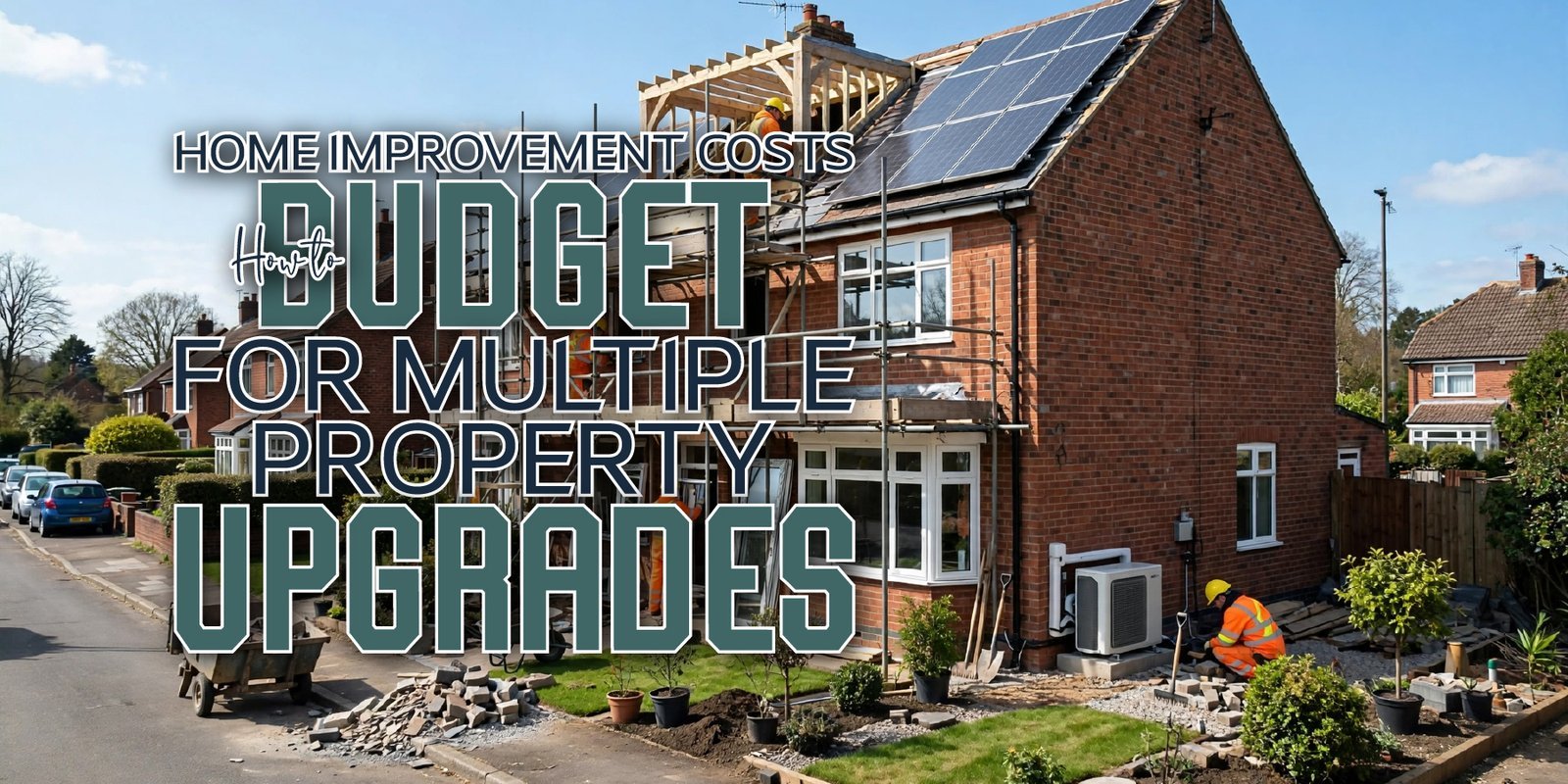
A homeowner may be considering a heat pump, better security, a bathroom renovation and replacement windows at the same time. Each project can make sense on its own, yet the combined home improvement budget can become difficult to control once preparation, labour, supporting trades, VAT, finishing and unexpected work enter the picture. Effective home improvement budgeting therefore requires more than adding together headline installation prices.
The better approach is to build one master home improvement plan. Rank projects by urgency, define the full scope of each job, identify dependencies between projects, separate upfront and ongoing costs, then compare itemised quotations on the same basis. That process turns home improvement costs from a collection of isolated prices into a budget that reflects how the property will actually be upgraded.
How Should You Budget for Multiple Home Improvements?
Homeowners should budget for multiple home improvement projects by listing every planned job, ranking urgent work first, estimating the complete project cost, including supporting and finishing work, allowing for genuine uncertainty, sequencing dependent projects and obtaining itemised quotes. Compare like-for-like scope before comparing totals, because the lowest headline price may simply include less work.
Begin with one property-wide home improvement list rather than separate notes for each trade. Include repairs, heating, security, bathrooms, windows, roofing, insulation, solar and larger renovation projects you are genuinely considering.
Next, divide the list into immediate needs and later choices. An active roof leak belongs ahead of a decorative home improvement because unresolved water ingress can damage finished work. Likewise, planned rewiring or major plumbing should usually be understood before expensive flooring or decoration.
Finally, build the home improvement budget around complete project scopes rather than products. A £6,000 bathroom allowance is not useful if it excludes electrical work, waste disposal and wall preparation that the homeowner will still have to pay for.
What Counts as a Home Improvement Cost?
A realistic home improvement cost can include the main product or construction work, labour, preparation, removal, waste disposal, supporting trades, finishing, professional fees, VAT, ongoing costs and an allowance for legitimate unforeseen work. The mix varies by project, so homeowners should identify which layers apply before comparing quotations.
Materials
Materials can include the obvious product, such as windows, sanitaryware or insulation, plus fixings, pipework, electrical accessories, adhesives, trims, membranes and other supporting materials.
Labour
Labour may involve one installer or several specialist trades. A bathroom can require a fitter, plumber, electrician and tiler. An extension may involve builders, electricians, plumbers, plasterers and decorators.
Preparation
Preparation can include surveys, strip-out, access work, removing existing fittings, surface preparation, protecting occupied areas or repairing defective substrates.
Removal and disposal
Old boilers, roofing, bathroom suites, windows, packaging, rubble and general construction waste all need an agreed disposal route. Never assume removal is included simply because installation is included.
Supporting trades
A core home improvement can trigger secondary work. A heat pump can require electrical work and emitter changes. A bathroom can require ventilation and electrical work. New windows may need making good around reveals.
Finishing
Decoration, flooring, plaster repairs, sealant, trims and final making good can sit outside the core installation price.
Surveys and professional fees
Larger projects can involve architects, structural engineers, surveyors, planning applications or building-control costs. These costs matter most on extensions, loft conversions and structural alterations, although other projects can also need specialist input.
VAT
Always check whether VAT is included in a quotation where it applies. Two totals cannot be compared fairly if one is shown inclusive and another exclusive.
Ongoing costs and maintenance
Some home improvement projects create long-term costs. Security monitoring may involve subscriptions. Heating systems use energy and may need servicing. Solar systems can require inverter replacement later.
Maintenance requirements should therefore sit beside the upfront price rather than disappearing from the decision.
Contingency
Contingency is money reserved for genuine uncertainty or hidden work, not a second budget for optional upgrades.
Why Headline Home Improvement Prices Can Be Misleading
Headline home improvement prices become misleading when different sources define the project differently.
One bathroom figure may include sanitaryware, labour and tiling. Another may represent labour only. One window quote may include removal and making good, while another may show supply and installation but exclude disposal.
A heat-pump figure may describe the equipment and standard installation while a property-specific quote includes radiator, cylinder and electrical changes.
Before comparing totals, ask:
- What exact work is included?
- Which products and specifications are included?
- Which supporting trades are included?
- What is explicitly excluded?
- What could create an additional charge?
If those answers differ, the quotations do not yet represent the same home improvement project.
The Home Improvement Budget Stack
The Home Improvement Budget Stack divides each project into six financial layers.
| Budget Layer | What It May Include |
|---|---|
| Core Work | Main product, installation, construction or renovation |
| Preparation | Surveys, removal, strip-out, access and repairs |
| Supporting Work | Plumbing, electrics, heating, ventilation or structural work |
| Finishing | Flooring, decoration, making good and final finishes |
| Professional Costs | Design, surveys, planning, building control or specialist advice |
| Contingency | Allowance for legitimate unexpected work |
Layer 1. Core Work
Start with the main home improvement objective. For windows, this could be supply and installation of the selected units. For a bathroom, it could be the agreed suite, shower and fitting work.
Layer 2. Preparation
Ask what must happen before the core job can begin. Existing items may need removal. Defective surfaces may need repair. Scaffolding or access may be needed.
Layer 3. Supporting Work
This layer exposes many hidden costs. Electrical, plumbing, ventilation, heating alterations and structural work can materially change the budget even when they are not the headline project.
Layer 4. Finishing
A completed technical installation does not always leave a completed room.
Add decorating, flooring, plaster repairs, trims and making good where the quote does not include them.
Layer 5. Professional and Administrative Costs
Major home improvement work may require professional design, engineering, planning, building-control or party-wall input. The need depends on the project and property.
Layer 6. Contingency
Keep this money separate. It exists for legitimate surprises rather than late upgrades chosen after the contract starts.
The Budget Stack makes one important point visible: the product price can be only one layer of the true home improvement project cost.
Which Home Improvements Should You Budget for First?
Homeowners should normally fund urgent repairs and significant safety or functional issues before optional cosmetic upgrades. After that, priorities can move towards protection, energy efficiency, everyday usability and larger transformative projects. The correct order depends on the property, household circumstances and any professional assessment of defects.
A useful order is:
Repair → Protect → Save → Improve → Transform
This home improvement order is not a rule that every household must follow mechanically.
Instead, it prevents a new kitchen or decorative project from absorbing the budget while the roof, electrics or other urgent condition issues remain unresolved.
The Repair, Protect, Save, Improve, Transform Budget Framework
1. Repair
Repair projects address something already damaged, failing or deteriorating.
Examples include leaks, roof repairs, defective windows and building problems that can worsen if ignored.
In a home improvement budget, Repair usually receives first attention because delay can create more work elsewhere.
2. Protect
Protect projects aim to improve security, resilience or resistance to future deterioration.
Examples can include stronger external doors, home security systems and appropriate external works.
Protection priorities vary. A homeowner with an identified security concern may reasonably place security above a cosmetic bathroom upgrade.
3. Save
Save projects aim to reduce energy demand or improve heating or electricity efficiency.
Examples include insulation, heat pumps, efficient windows and solar panels.
These projects may reduce energy use or bills in suitable circumstances, but no saving should be guaranteed. The financial result depends on system design, tariffs, property condition and household behaviour.
4. Improve
Improve projects focus on everyday comfort and usability.
Bathrooms, kitchens, storage and internal improvements belong here when they do not address urgent defects.
5. Transform
Transform projects significantly change space or layout.
Extensions, loft conversions and major structural alterations generally need larger home improvement budgets, more professional input and more sequencing.
Separate Essential Work From Optional Upgrades
A property-wide home improvement budget becomes easier to control when projects are separated into three decision levels.
Essential
These are active defects, safety concerns and significant functional failures.
Examples include water ingress, dangerous defects or a heating failure during winter.
Important
These projects may improve security, efficiency, maintenance, comfort or usability without being immediate emergencies.
Optional
These are mainly aesthetic or lifestyle-driven changes that can often wait without causing further damage.
A home improvement project can move between levels. A window replacement may be optional where existing windows remain sound, but essential where frames are badly deteriorated or unsafe.
How to Create a Renovation Budget
Use this ten-step home improvement budgeting process.
1. List every planned project
Create one master home improvement list rather than separate trade lists.
2. Identify urgent work
Flag repairs, safety issues and anything that can damage other completed work.
3. Define project scopes
State what the project is supposed to achieve.
“New bathroom” is too vague.
“Retain toilet position, replace bath with shower, add vanity, update ventilation and replace flooring” is far more useful.
4. Research indicative costs
Use current UK guides to understand broad scale, then stop treating them as quotations.
5. Obtain relevant quotations
Once the home improvement scope is clear, request written prices from suitable installers.
6. Include supporting work
Add electrics, plumbing, scaffolding, making good, ventilation or specialist work where relevant.
7. Add professional costs
For major structural or regulated work, include design, engineering, planning or building-control costs where they apply.
8. Identify dependencies
Ask whether another home improvement should happen before or after this project.
9. Allow for uncertainty
Create a contingency that reflects property condition and the amount of unknown work.
10. Build a phased total
Combine all projects into one budget and decide what can be funded now, later or only if other projects remain within budget.
Build a Master Home Improvement Budget
Use a master table.
| Project | Priority | Indicative Budget | Quotes Received | Dependencies | Planned Timing |
|---|---|---|---|---|---|
| Roof repair | Must Do | Before internal decoration | |||
| Heat pump/heating | Should Do | After heat-loss/fabric decisions | |||
| Bathroom | Should/Could Do | Coordinate plumbing/electrics | |||
| Security | Should/Could Do | Consider cabling/decorating | |||
| Windows | Property-specific | Coordinate with insulation/exterior work | |||
| Loft/extension | Transform | Before final internal finishes |
The purpose of this home improvement table is not perfect forecasting.
Instead, it forces the household to see the whole programme before committing most of the available cash to the first attractive project.
Home Improvement Costs by Project Type
Current UK home improvement figures can help homeowners understand order of magnitude, but they are not interchangeable.
| Project | Current Indicative UK Reference | Main Scope Warning |
|---|---|---|
| Air source heat pump | Around £12,000 typical installation | Radiators, cylinder and electrical work can change scope |
| Basic burglar alarm | Starting around £500–£525 supply and install | Sensors, CCTV and monitoring increase cost |
| Bathroom renovation | Around £1,500–£7,500 in one remodel guide; many supplied-and-installed bathrooms £5,500–£8,000 | Definitions differ |
| Standard uPVC casement window | Around £500–£1,250 each | Frame, size and installation complexity vary |
| Roof replacement | Around £4,000–£19,000 | Roof type, size and access dominate |
| Loft insulation | Around £750 for a typical uninsulated semi | Property size and existing insulation matter |
| Solar PV | Around £7,600 for a typical 4.5kWp system | Roof access, size and battery choice vary |
| Boiler replacement | Broadly £3,000–£15,000 across system types | Fuel, boiler type and installation complexity vary |
| Loft conversion | Roughly £30,000–£70,000 | Roof form and specification dominate |
| Single-storey extension | Around £1,800–£3,000/m² | Location, structure and fit-out matter |
These are planning references, not promises.
Actual home improvement quotations take precedence because property condition, location, specification and scope can materially alter every figure.
Heat Pump Costs: What Should Homeowners Budget For?
For this home improvement, current Energy Saving Trust guidance gives a typical air source heat pump installation at around £12,000. The final amount can change with heat loss, system capacity, radiator upgrades, hot-water cylinder requirements and electrical work.
Separate:
- core equipment;
- installation labour;
- survey and design;
- radiator or underfloor-heating changes;
- cylinder work;
- controls;
- electrical work;
- grant treatment;
- ongoing electricity use;
- maintenance.
Grant support can reduce the homeowner contribution where eligibility applies, but it should not be confused with the gross project price.
For a deeper heating-specific breakdown, use the heat pump costs and benefits guide.
A heat pump also shows why home improvement sequencing matters. If the homeowner plans insulation or major window work that could materially change heat demand, those decisions should be shared with the heating designer before final sizing.
Home Security Costs: What Should You Compare?
Security home improvement costs can include equipment, installation and ongoing services.
Current March 2026 Checkatrade guidance lists starting supplied-and-installed prices around £500–£525 for basic burglar-alarm examples and around £650 for its basic smart-alarm example. Its CCTV example starts around £800 for equipment before labour.
Build the security budget around:
- cameras or sensors;
- control equipment;
- installation;
- cabling;
- cloud storage;
- monitoring;
- subscriptions;
- maintenance;
- future expansion.
A low equipment price can become a different long-term proposition once recurring monitoring or storage is added.
Homeowners considering security can compare security services separately from unrelated renovation costs.
Bathroom Renovation Costs
Bathroom home improvement costs are a strong example of why scope definitions matter.
Checkatrade’s May 2026 remodel guide gives a broad £1,500–£7,500 range with an average around £4,500. Its March 2026 new-bathroom guide gives £5,500–£8,000 for many supplied-and-installed projects, averaging around £7,000, with more complex work at £14,000+.
The figures are not necessarily contradictory. They describe differently defined projects.
Budget for:
- removal;
- sanitaryware;
- plumbing;
- electrical work;
- ventilation;
- waterproofing;
- tiling;
- flooring;
- labour;
- waste;
- decoration.
When planning this home improvement, decide whether the quote is labour-only, product-inclusive or full supply-and-fit.
Kitchen Renovation Costs
Kitchen costs vary so widely that a single national average can be misleading.
Current FMB renovation guidance says new kitchens generally start around £10,000, while layout, cabinetry, worktops, appliances and fittings can move the total substantially higher.
A kitchen home improvement budget should separate:
- cabinets;
- worktops;
- appliances;
- sink and taps;
- electrical work;
- plumbing;
- extraction;
- flooring;
- installation;
- decoration.
Moving sinks, appliances or walls can change the supporting-work layer more than changing door colour or worktop finish.
Window and Door Upgrade Costs
Current Checkatrade guidance lists standard uPVC casement double-glazed windows at roughly £500–£1,250 per window, with sash, tilt-and-turn and bay windows carrying different ranges.
Window home improvement costs depend on:
- number of units;
- dimensions;
- frame material;
- glazing specification;
- opening style;
- access;
- installation;
- disposal;
- making good.
For doors, apply the same principle.
Compare the complete specification, security hardware, glazing, installation and finishing rather than one “front door price”.
Insulation Costs
Energy Saving Trust currently gives approximately £750 for professionally installing 270mm of loft insulation in a typical previously uninsulated semi-detached home and around £600 when topping up from 120mm to 270mm.
Its current solid-wall guidance gives around £15,000 for external wall insulation on a typical three-bedroom semi-detached home.
This illustrates why “insulation” is not one home improvement price category.
Loft, cavity-wall, internal-wall and external-wall projects have very different work, disruption and cost structures.
Roofing and External Work
For roofing home improvement, current March 2026 Checkatrade guidance puts roof replacement broadly between £4,000 and £19,000, with an average around £8,000 across its modelled examples.
Roof type, area, material, scaffolding, access and hidden timber or structural deterioration can all change the final home improvement cost.
A repair should not automatically be budgeted as a complete replacement.
Likewise, a replacement quotation should clearly show scaffolding, coverings, membranes, flashings, waste and any timber work included.
Solar Panel Costs
Energy Saving Trust’s July 2026 guidance says a typical domestic solar PV system of around 4.5kWp costs approximately £7,600 to install.
The cost depends on:
- system size;
- roof access;
- mounting approach;
- whether roof work is required;
- whether battery storage is added.
For long-term home improvement budgeting, also consider inverter replacement and maintenance rather than looking only at installation.
Do not assume one annual saving or payback period applies to every household.
Solar performance and financial results vary with electricity consumption, export arrangements, location and system design.
Boiler Replacement Costs
Current March 2026 Checkatrade guidance gives a broad £3,000–£15,000 total range once installation and typical extras are considered across its different boiler categories.
That range is too broad to use as a property-specific budget without further definition.
A boiler home improvement quote should identify:
- boiler type;
- controls;
- installation;
- filters;
- required system work;
- radiator or pipework changes.
Gas work requires appropriately registered professionals, so installer competence forms part of the project rather than being an optional extra.
Larger Renovation Projects
Loft conversions
Current FMB guidance gives approximately:
- rooflight/Velux: from £30,000;
- dormer: £50,000;
- hip-to-gable: £60,000;
- mansard: £70,000.
The figures depend on property location, complexity and specification.
The actual home improvement budget also depends on structure, stairs, insulation, fire-safety requirements, windows, services and whether an en-suite is included.
Extensions
Current FMB guidance places typical single-storey extensions around £1,800–£3,000 per m², with London, the South East, specification and structural complexity affecting cost.
The building shell is only part of the total.
Kitchens, bathrooms, flooring, large glazed doors, heating and decoration can sit on top of the basic build.
Professional fees and relevant planning or building-control costs may also apply.
Major layout alterations
Removing walls, changing structure or reconfiguring several rooms can combine design, structural, electrical, plumbing and finishing costs.
For these home improvement projects, a one-line “building work” allowance is rarely sufficient.
The Budget, Benefit, Disruption, Dependency Scorecard
Evaluate every proposed home improvement through four questions.
| Factor | Question |
|---|---|
| Budget | What is the complete project cost, not just installation? |
| Benefit | Which problem does it solve: repair, security, efficiency, comfort, appearance or space? |
| Disruption | How much access, downtime, dust or room loss could occur? |
| Dependency | Which project must happen before or after it? |
Suppose a homeowner has £30,000 available and is considering a bathroom, new flooring, windows and major plumbing alterations.
The bathroom may score highly on usability, but installing expensive flooring throughout the home before disruptive plumbing creates a dependency problem.
The scorecard therefore prevents the home improvement budget from being allocated solely according to project desirability.
Why Project Sequencing Matters
Bad sequencing can make a home improvement budget pay for the same surface twice.
Examples include:
- decorating before rewiring;
- laying flooring before structural or plumbing work;
- completing bathroom finishes before hidden leaks are resolved;
- installing radiators before deciding on a wider heating change;
- landscaping before heavy extension access is complete.
Before approving every home improvement project, ask:
What later job could disturb this work?
That question can expose avoidable duplication before money is spent.
How to Sequence Multiple Home Improvements
A useful general sequence is:
1. Investigations and surveys
Resolve uncertainty around structure, damp, drainage, electrics or other important issues.
2. Urgent repairs
Stop active deterioration and make the property appropriately secure and weather-resistant.
3. Structural or major building work
Complete extensions, loft work and structural alterations before delicate finishes.
4. Heating, plumbing and electrical infrastructure
Coordinate hidden services while walls and floors are already being disturbed.
5. Windows and external work where relevant
Sequence these around rendering, insulation and internal finishing.
6. Internal installation projects
Kitchens, bathrooms, joinery and other fitted home improvement projects can follow once major hidden work is settled.
7. Finishing and decoration
Complete final flooring and decoration after disruptive phases.
Actual home improvement sequencing depends on the property. This is a planning framework, not a universal construction programme.
What Hidden Home Improvement Costs Should You Expect?
Hidden home improvement costs are often not mysterious costs. They are normal project items that were missing from the first budget or quote. Possible examples include strip-out, waste disposal, making good, scaffolding, electrical upgrades, plumbing changes, access equipment, surveys, professional fees and temporary accommodation.
Potential categories include:
- removal;
- skips and waste;
- making good;
- plastering;
- electrical upgrades;
- plumbing alterations;
- scaffolding;
- access equipment;
- delivery;
- storage;
- specialist surveys;
- planning costs;
- building-control costs;
- temporary accommodation;
- decoration.
Not every home improvement needs all of them.
Instead of adding an arbitrary “hidden-cost percentage”, use the Budget Stack and identify which layers remain unpriced.
What Is a Renovation Contingency?
A renovation contingency is money reserved for genuine unforeseen costs that could not reasonably be confirmed before work began. It should not be treated as a fund for optional specification upgrades. The appropriate contingency depends on project type, property age, existing condition, how invasive the work is and how much uncertainty remains after surveys.
Current FMB 2026 budgeting guidance recommends around 10% as a general contingency and suggests 15% or more for older properties or projects involving structural alterations.
That is useful industry guidance, not a legal rule.
A well-surveyed modern bathroom replacement may justify a different risk allowance from opening an older house for extensive structural work.
Should You Use One Contingency for the Entire Renovation?
Not necessarily.
For several home improvement projects, separate contingencies can make risk easier to understand.
A window-replacement project with well-defined dimensions may contain less hidden-condition risk than structural alteration in an older property.
For a phased renovation, attach contingency to each project and retain an overall programme reserve only where shared dependencies create genuine uncertainty.
This approach reduces the risk that one project consumes money intended to protect another.
Upfront Costs vs Ongoing Costs
| Project Type | Main Upfront Cost | Potential Ongoing Cost |
|---|---|---|
| Heat pump | Equipment, design and installation | Electricity, servicing/maintenance |
| Security monitoring | Equipment and installation | Subscription, cloud storage, maintenance |
| Windows | Units and installation | Maintenance and eventual hardware/seal repairs |
| Bathroom | Products and fitting | Routine maintenance and repairs |
| Solar | Panels, inverter and installation | Maintenance and eventual inverter replacement |
| Boiler | Boiler and installation | Fuel, servicing and repairs |
A home improvement budget that stops at installation can distort comparison between projects.
Security is a clear example. A monitored alarm may have a modest installation difference but a recurring service cost.
Similarly, heating upgrades affect household energy spending for many years.
Why Ongoing Costs Matter
Ongoing costs change the long-term affordability of a home improvement.
Review:
- energy use;
- monitoring subscriptions;
- cloud storage;
- service plans;
- routine servicing;
- consumables;
- replacement parts;
- warranties that require maintenance.
For homeowners comparing security, the home security upgrade costs guide is a more relevant place to compare cameras, alarms, monitoring and recurring services than folding those costs into an unrelated renovation quotation.
Compare Home Upgrades’ current security page itself treats equipment, monitoring and installation as distinct comparison factors.
What Should a Home Improvement Quote Include?
A home improvement quote should define the project scope, product or material specification, labour, installation, preparation, supporting trades, removal, waste disposal, finishing, VAT, warranty, programme, payment schedule, exclusions and optional extras. Where relevant, it should also identify professional costs and ongoing fees.
Check:
- project scope;
- measurements or quantities;
- products and materials;
- specification;
- labour;
- preparation;
- installation;
- supporting trades;
- electrical work;
- plumbing work;
- removal;
- waste disposal;
- making good;
- finishing;
- professional fees;
- VAT;
- warranty;
- programme;
- payment schedule;
- exclusions;
- optional extras;
- ongoing costs.
Current 2026 UK builder guidance similarly emphasises scope, materials, subcontractors, waste, VAT, exclusions, staged payments and variation processes.
The more expensive the home improvement, the more costly ambiguity can become.
The Home Upgrade Quote Comparison Test
Compare every quotation across 21 points:
- Scope
- Materials
- Product specification
- Labour
- Preparation
- Removal
- Waste disposal
- Installation
- Supporting trades
- Electrical work
- Plumbing work where relevant
- Finishing
- Warranty
- Timescale
- VAT
- Payment schedule
- Exclusions
- Optional extras
- Ongoing running costs
- Ongoing maintenance
- Total project cost
For each line, mark:
included / excluded / allowance / homeowner-supplied / unclear
An unclear item should be resolved before choosing between home improvement quotations.
How to Compare Home Improvement Prices Like for Like
Do not compare total home improvement price until you compare total scope. Two installers can quote different totals because they have specified different products, preparation, supporting trades, warranties or exclusions. Convert each quotation into the same checklist first; only then compare the final payable amount.
For home improvement price comparison, use a common table:
| Quote Item | Installer A | Installer B | Installer C |
|---|---|---|---|
| Materials | |||
| Labour | |||
| Preparation | |||
| Supporting trades | |||
| Waste removal | |||
| Finishing | |||
| Warranty | |||
| VAT | |||
| Exclusions | |||
| Total |
A £15,000 home improvement quotation that includes preparation, specialist work and finishing cannot be fairly compared with a £12,000 quotation that excludes them.
Once each project has a defined scope, homeowners can compare home improvement quotes for supported categories through Compare Home Upgrades.
Why the Cheapest Quote May Not Be the Best Value
The cheapest home improvement quotation may be the right choice, but price alone cannot prove value.
Lower totals can reflect:
- lower specification;
- less preparation;
- excluded waste;
- omitted supporting work;
- shorter warranty;
- different assumptions.
However, the highest quotation is not automatically better either.
Premium products or unnecessary extras can raise cost without solving the household’s actual problem.
Value means the quotation delivers the right scope and specification at a total cost the homeowner understands.
How Many Upgrade Quotes Should You Get?
There is no universal number for every home improvement sector.
For significant building work, current FMB and Which? guidance commonly encourages several detailed quotations. Which?’s 2026 extension guidance recommends at least three detailed, itemised quotations and comparing them line by line.
FMB also emphasises detailed comparisons for major renovation work.
The home improvement goal is not collecting the largest possible pile of estimates.
It is obtaining enough credible, comparable quotations to understand:
- scope;
- specification;
- price;
- exclusions;
- programme;
- installer approach.
How to Compare Quotes Across Different Home Improvements
Do not decide whether a heat pump or bathroom offers “better value” solely by comparing price.
Instead, compare every home improvement according to:
- urgency;
- problem solved;
- household benefit;
- disruption;
- expected lifespan;
- ongoing costs;
- maintenance;
- dependencies.
A £5,000 repair that prevents further building deterioration can have a higher budget priority than a £5,000 aesthetic project.
Likewise, a £15,000 space-creating project may solve a larger household problem than several smaller decorative upgrades.
Should You Complete All Home Improvements at Once?
Completing several home improvement projects together can improve coordination, but it also increases financial and programme complexity.
Potential advantages
- shared access or scaffolding;
- fewer repeated disturbances;
- better coordination between services and finishes;
- one overall design direction.
Potential disadvantages
- larger upfront cash requirement;
- more trades on site;
- more scheduling dependencies;
- greater household disruption;
- one delay affecting several projects.
There is no universal correct strategy.
The best home improvement approach depends on cash flow, dependencies, property condition and how much disruption the household can manage.
Phased Renovation Budget vs Whole-Project Budget
| Factor | Phased | Whole Project |
|---|---|---|
| Upfront budget | Lower per phase | Higher |
| Disruption | Repeated over time | More concentrated |
| Coordination | Simpler within each phase | More complex overall |
| Flexibility | Higher | Lower once commitments are made |
| Sequencing | Needs careful phase boundaries | Easier to coordinate globally |
| Financial exposure | Spread over time | More simultaneous |
Phasing can work well where home improvement projects are largely independent.
It works less well where a later phase will disturb work completed earlier.
How to Prioritise When the Budget Cannot Cover Everything
Use this order as a decision aid:
- Safety and urgent repairs.
- Work that prevents further deterioration.
- Essential household function.
- Energy or security priorities.
- Comfort and usability.
- Cosmetic work.
A property’s condition can change this hierarchy.
For example, security may become urgent after an external door is damaged, while a heating project can become essential after a system failure.
The framework protects the home improvement budget from being allocated according to visual appeal alone.
Common Home Improvement Budgeting Mistakes
Budgeting from headline prices only
A headline price rarely shows every layer of the project.
Ignoring VAT
Confirm that every quotation treats VAT consistently.
Ignoring preparation
Surveys, strip-out and surface repairs may be unavoidable.
Forgetting waste removal
Removal and disposal can be separate charges.
Missing supporting trades
The main installer may not include electrical, plumbing or other specialist work.
Comparing different scopes
Different projects cannot produce a fair price comparison.
Spending on cosmetic work before urgent repairs
Underlying defects can damage new finishes.
Poor project sequencing
Later work can force homeowners to pay for making good twice.
Ignoring ongoing costs
Subscriptions, servicing and energy use matter after installation.
Treating contingency as decoration money
Contingency should protect the budget from uncertainty rather than pay for premium finishes.
Ordering too early
Products can prove incompatible with final measurements or project design.
Choosing solely on price
Scope, specification, warranty and exclusions matter.
How to Keep a Home Improvement Budget Under Control
Start with a written home improvement scope for each project.
Then:
- use itemised written quotations;
- record quote assumptions;
- agree changes before extra work proceeds;
- price variations in writing;
- keep contingency separate;
- avoid uncontrolled specification upgrades;
- track actual spending against each Budget Stack layer;
- review the overall programme after each major phase.
Current FMB budgeting guidance similarly recommends written agreements, clear inclusions and exclusions, payment stages and written variation costs.
The best control mechanism is not aggressive cost-cutting.
It is preventing unclear work from entering the home improvement budget unnoticed.
Questions to Ask Before Approving an Upgrade Quote
Ask:
- What exactly is included?
- What is excluded?
- Which products and materials are specified?
- Is labour fully included?
- What preparation is included?
- Who handles removal and waste?
- Are supporting trades included?
- Is electrical or plumbing work included where relevant?
- Is finishing or making good included?
- Is VAT included?
- What warranty applies?
- What payment schedule applies?
- How long is the quotation valid?
- What could legitimately change the price?
- How will variations be agreed?
- Are ongoing subscriptions, servicing or maintenance costs involved?
These questions make home improvement quotations easier to compare before a contract is agreed.
How Compare Home Upgrades Can Help With Project Research
Compare Home Upgrades currently positions itself as a UK comparison resource covering home improvements, heating and security rather than as the contractor physically completing every project.
That distinction matters.
The platform becomes more useful after the homeowner has clarified the home improvement project well enough to compare meaningful options.
For heating, its heat pump installation costs guide separates installation, system design, related works and ongoing costs. The current live page also emphasises comparing full scope rather than appliance price alone.
For security, homeowners can compare home security options while keeping recurring monitoring and storage charges visible.
Once several home improvement scopes are defined, homeowners can compare upgrade quotes for relevant supported categories.
Build the Budget Around the Whole Project, Not the Headline Price
A reliable home improvement budget starts with priorities.
Repair active problems first. Protect the property where necessary. Then assess energy, comfort and space upgrades against the benefit they actually provide.
Next, build each home improvement through the Home Improvement Budget Stack:
core work → preparation → supporting work → finishing → professional costs → contingency
Sequence the programme before ordering expensive products.
A bathroom, heating upgrade, roof project and extension may all be worthwhile, but their dependencies determine when money should be spent.
Finally, compare the complete quotation.
Materials, labour, preparation, supporting trades, waste, finishing, VAT, ongoing costs, warranty and exclusions all affect the real home improvement price.
Once you know which upgrades deserve priority and what each scope should contain, you can compare relevant home improvement quotes based on the work your property actually needs.
Frequently Asked Questions About Home Improvement Costs
1. How do I budget for home improvements?
Build one list of planned home improvement projects, rank urgent repairs first, define the scope of each project and research current indicative costs. Then add preparation, supporting work, finishing, professional fees and contingency where relevant. Finally, obtain itemised quotations and compare the same scope before committing money.
2. What counts as a home improvement cost?
A complete home improvement cost can include products, materials, labour, installation, preparation, removal, waste disposal, supporting trades, making good, professional fees, VAT, maintenance, running costs and genuine unforeseen work. Not every category applies to every project, so identify which layers belong in each individual budget.
3. How should I prioritise multiple home upgrades?
Start with safety issues, urgent repairs and work that prevents further deterioration. Next, consider essential function, security, energy efficiency, comfort and usability. Cosmetic work can normally follow. However, the correct home improvement priority depends on the actual property condition and household circumstances.
4. What hidden renovation costs should I budget for?
Potential hidden costs include strip-out, waste, scaffolding, access, making good, electrical alterations, plumbing changes, surveys, structural advice, planning or building-control costs, delivery, storage and temporary accommodation. Instead of assuming all apply, review the Home Improvement Budget Stack and identify which project layers remain unpriced.
5. What is a renovation contingency?
A contingency is money reserved for genuine unexpected work. Current FMB guidance suggests around 10% as a broad starting point and potentially 15% or more for older or structurally complex projects, although the appropriate amount depends on property condition and uncertainty.
6. Should I renovate one room at a time?
Sometimes. Phasing can reduce immediate financial pressure and give homeowners more flexibility. However, completing connected home improvement work separately can cause repeat disruption or making good. Structural, electrical, plumbing and heating dependencies should therefore be considered before deciding whether to renovate in phases.
7. Should urgent repairs come before cosmetic upgrades?
Usually, yes. Active leaks, structural concerns or serious defects can damage new decoration and fitted finishes. Addressing relevant underlying problems first can prevent duplicated spending. Seek appropriate professional advice where the condition or cause of a defect is uncertain.
8. What should a home improvement quote include?
A useful home improvement quote should identify scope, products, materials, labour, preparation, installation, supporting trades, removal, waste disposal, finishing, VAT, warranty, programme, payment schedule, exclusions and optional extras. Ongoing subscriptions or maintenance should also be identified where relevant.
9. Why can home improvement quotes vary so much?
Quotes can differ because installers use different specifications, materials, quantities, preparation assumptions, labour, supporting trades, warranties or exclusions. One quotation may also include work another excludes. Therefore, homeowners should compare scope first and total home improvement price second.
10. How do I compare home improvement prices fairly?
Give installers the same project information and convert each quotation into one comparison checklist. Review materials, labour, preparation, supporting trades, waste, finishing, VAT, warranty and exclusions before comparing totals. If a line is unclear, ask for clarification rather than assuming it is included.
11. Should I choose the cheapest installer quote?
Not automatically. A lower home improvement quote may represent excellent value, or it may contain a narrower scope or lower specification. Conversely, the highest quotation is not automatically better. Compare the suitability of the scope, specification, warranty, exclusions and total cost.
12. How should I sequence multiple renovation projects?
Investigate defects first, then complete urgent repairs and major structural work. Coordinate hidden heating, plumbing and electrical infrastructure before expensive fitted interiors or decoration. Windows and external work should also be coordinated with insulation or rendering where relevant. The precise sequence depends on the property.