
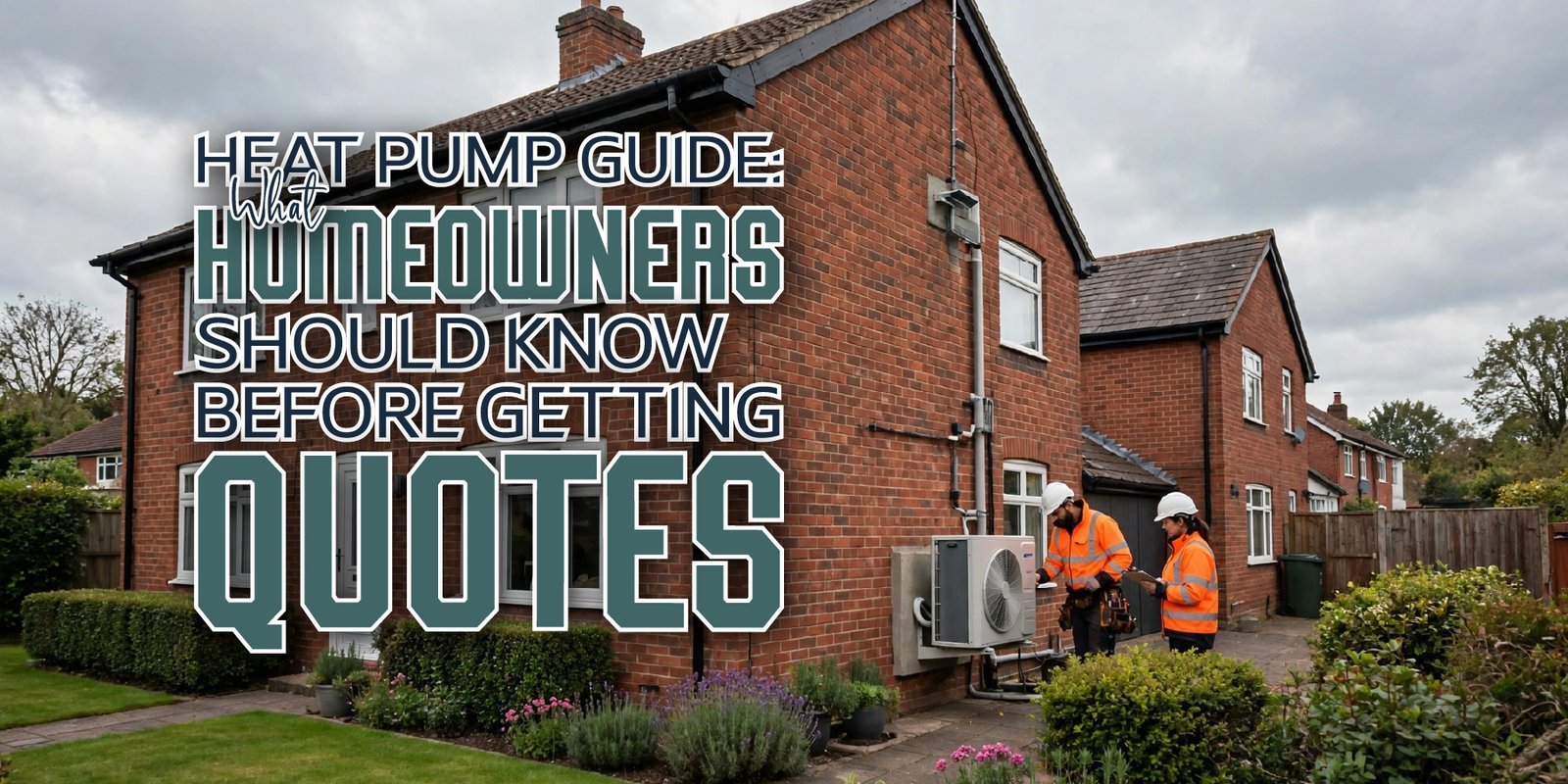
Two heat pump quotations can look similar at first glance and still describe very different heating projects. One may include radiator upgrades, a new hot-water cylinder and electrical work, while another may price little beyond the outdoor unit and basic installation. Understanding a heat pump before comparing quotes makes it much easier to see what each installer has actually designed, included and excluded.
For most homeowners, the important decision is not simply which heating-system brand to buy. A successful heat pump installation depends on the home, its heat loss, the proposed flow temperature, the radiators or underfloor heating, hot-water demand, controls and the quality of the system design. This guide explains those factors in homeowner language so you can compare complete systems rather than headline equipment prices.
What Is a Heat Pump?
A heat pump is an electrically powered heating system that moves heat from a source such as outdoor air, the ground or water into a home. Instead of producing most of its heat through combustion, the system uses a refrigeration cycle to raise the temperature of captured heat and transfer it into space heating and, for many systems, stored hot water.
That difference explains why the system can deliver more heat energy than the electrical energy used to run its compressor. However, the efficiency achieved in a real property depends heavily on design conditions, flow temperature, outdoor temperature and the building’s heating demand.
In UK homes, the two types homeowners most often compare are an air source heat pump and a ground source heat pump. Air source systems are more common because they avoid the extensive trenches or boreholes associated with ground source installations.
How Does a Heat Pump Work?
A heat pump moves heat through a closed refrigeration cycle. In an air source heat pump, the outdoor unit absorbs heat from outside air into a refrigerant. A compressor raises the refrigerant’s pressure and temperature, and a heat exchanger then transfers that heat into the home’s heating circuit. The refrigerant continues through the cycle and repeats the process.
Therefore, the system needs electricity to run the compressor, pumps, controls and other components, but the useful heat delivered can be several times the electrical input under appropriate conditions. That ratio changes with operating conditions rather than remaining fixed throughout the year.
For homeowners, the practical implication is straightforward: do not compare equipment only by nominal capacity or a single efficiency figure. The complete design determines how the equipment is expected to perform in your home.
What Is an Air Source Heat Pump?
An air source heat pump extracts usable heat from outdoor air. The most common whole-home type in the UK is an air-to-water system, which transfers that energy into a wet central-heating circuit serving radiators or underfloor heating and can also heat water stored in a cylinder.
Air-to-air systems work differently. They transfer heat into indoor air rather than a wet radiator circuit and may also provide cooling. Current Boiler Upgrade Scheme support distinguishes between air-to-water and air-to-air systems, so homeowners should confirm exactly which technology a quote describes.
An air source heat pump needs an appropriate outdoor-unit location with suitable airflow, access and planning consideration. Indoor requirements vary by system, particularly where a hot-water cylinder or other hydraulic equipment is needed.
Air Source vs Ground Source Heat Pumps
Both systems use the same broad refrigeration principle, but the heat source and installation work differ.
| Factor | Air Source | Ground Source |
|---|---|---|
| Heat source | Outdoor air | Ground via buried loops or boreholes |
| Outdoor work | Outdoor unit and connections | Trenches or boreholes plus ground loop |
| Land requirement | Suitable unit location | Suitable land or borehole access |
| Installation complexity | Usually lower | Usually higher |
| Typical upfront cost | Lower than ground source | Higher, especially with boreholes |
| Best fit | Many existing UK homes | Homes/sites with suitable land, access and budget |
A ground source heat pump can benefit from more stable ground temperatures, while an air source heat pump is generally simpler to install. Neither is universally better. Property constraints, heat demand, capital budget and access determine which system is more realistic.
Are Heat Pumps Suitable for UK Homes?
A heat pump can suit many UK homes, including older properties, but suitability depends on the building and the proposed system design. The key questions are how much heat the home loses, whether the emitters can deliver enough heat at the proposed water temperature, where equipment can be located, how hot water will be stored and what electrical or pipework changes are needed.
Energy Saving Trust currently describes heat pumps as suitable for most UK homes while still emphasising property-specific assessment.
Insulation is important because lower heat loss reduces the amount of heat the system must supply. However, a home does not need to become a perfect modern building before a heat pump can ever work. The installer should assess the property rather than applying a blanket rule based on age or EPC rating alone. Energy Saving Trust’s current fact check likewise rejects the idea that every home must be “fully insulated” before a system can work.
An older house with appropriate fabric improvements, correctly sized radiators and a sound design may be a better candidate than a newer property with poor system assumptions. That is why heat pump suitability should be established through survey and design rather than marketing shorthand.
The Heat Pump Readiness Test
The Heat Pump Readiness Test is a homeowner preparation framework. It is not a professional heat-loss calculation, technical survey or substitute for system design.
Building Fabric
How well does the home retain heat? Consider insulation, glazing, draughts and known areas of heat loss. Fabric improvements can reduce heating demand and may influence the required heat pump capacity or radiator sizes.
Heat Loss
Has the installer completed, or committed to complete, an appropriate room-by-room heat-loss assessment? Whole-house floor area alone is not enough to design emitters accurately.
Heat Emitters
Can the existing radiators or underfloor heating deliver enough heat at the proposed flow temperature? Some radiators may already be suitable, while others may need changing.
Hot Water
How much stored hot water does the household need, and where will the proposed cylinder or alternative arrangement go? A former combi-boiler home often needs more thought here.
Outdoor Space
Is there a sensible location for the outdoor unit, with airflow, access for maintenance and appropriate consideration of neighbours, appearance and planning requirements?
Electrical Supply
What electrical work does the proposed heat pump installation require? The quote should identify it rather than leaving an undefined allowance.
Controls
How will the system be controlled? Weather compensation, thermostatic strategy and system settings can affect comfort and efficiency.
Household Behaviour
Are occupants comfortable with a heating system that may operate for longer periods at lower water temperatures rather than delivering short bursts of very hot radiator output?
If several of these answers are unclear, the next step is better assessment rather than choosing equipment from a brochure.
Does a Home Need Better Insulation Before Installing a Heat Pump?
Not every home needs the same insulation work before a heat pump installation. Better insulation can reduce heat loss, lower the required heating output and make lower flow temperatures easier to achieve, but the sensible measures depend on the property.
A competent design should identify the home’s current heat demand and show how planned fabric improvements would change it. For example, improving loft, wall or floor insulation can alter room-by-room losses and therefore the radiator output required. MCS emitter guidance explicitly demonstrates how reducing fabric and ventilation losses can support lower heating-water temperatures.
The useful question is not “must I insulate everything first?” but “which realistic fabric improvements materially affect this heating design?” That answer should be based on the building rather than a generic EPC target.
Why Heat-Loss Calculations Matter
Heat-loss calculation is one of the most important parts of heat pump design because the system and each room’s emitters need to meet heating demand during cold design conditions.
Current MCS guidance uses room-by-room information including building fabric, room dimensions, ventilation or air-change assumptions, desired internal temperatures and local winter design temperatures.
Undersizing can leave the system unable to meet demand in the intended way. Oversizing can also be undesirable because equipment selection, cycling behaviour, capital cost and control may suffer when design assumptions are poor.
A quote should therefore connect the room-by-room heat loss to the selected unit output, proposed flow temperature and emitter sizes. If those links are missing, two apparently similar quotes may be based on very different design quality.
Do Heat Pumps Work With Existing Radiators?
Yes, a heat pump can work with existing radiators if those radiators provide enough heat at the proposed system temperatures. A heat pump installation does not automatically require every radiator to be replaced.
The important comparison is room by room. Radiator output falls as water temperature falls, so an emitter that worked with a high-temperature boiler may or may not provide enough output at a lower heat pump flow temperature. Some homes already have generously sized radiators, while others need selected upgrades. Energy Saving Trust confirms that existing radiators can sometimes remain where their output is adequate.
Ask the installer to identify which radiators can remain, which need changing, what output each room requires and what flow temperature the design assumes. A quote that simply states “radiator upgrades included” without detail is difficult to compare.
Heat Pump Flow Temperature Explained
Flow temperature is the temperature of the water leaving a hydronic heat pump and travelling towards radiators or underfloor heating. In general, lower required flow temperatures help the equipment operate more efficiently because the system has to lift the source heat through a smaller temperature difference.
Energy Saving Trust’s installer guidance shows how output and seasonal performance change as flow temperature changes, while MCS emitter guidance connects lower flow temperatures with building heat loss and radiator capacity.
Lower-temperature operation also changes how the home feels. Radiators may feel warm rather than very hot, and the heating system may run for longer periods to maintain a steady indoor temperature.
Flow temperature is therefore a design decision, not just a user setting. It links the building’s heat loss, radiator capacity, outdoor design conditions and expected seasonal performance. When comparing heat pump quotes, ask for the design flow temperature and why it was chosen.
Do Heat Pumps Provide Hot Water?
Many air-to-water and ground-to-water heat pump systems provide domestic hot water as well as space heating. Rather than producing hot water instantly like a combi boiler, they commonly heat water stored in a compatible cylinder.
Cylinder size should reflect household demand, available space and system design. The heat pump quote should say whether a new cylinder is included, what capacity is proposed, where it will be installed and whether any existing equipment is retained.
Hot-water design also affects control strategy and electricity use, so it should not appear as a vague optional extra added after the main quote.
Does a Heat Pump Need a Hot-Water Cylinder?
A typical whole-home air-to-water heat pump usually needs a way to store domestic hot water, commonly a cylinder. However, not every heating arrangement is identical. Air-to-air systems, heat batteries, hybrid configurations and other designs can handle hot water differently.
Energy Saving Trust notes that a standard air source system does not normally deliver instantaneous domestic hot water like a combi boiler, so storage arrangements need to be considered.
For a homeowner moving from a combi boiler, cylinder space can be one of the most practical constraints. Before accepting a quote, establish the proposed hot-water arrangement, its size, location, included controls and whether installation requires changes to cupboards, pipework or electrical supplies.
How Much Does a Heat Pump Cost in the UK?
Heat pump cost varies substantially by technology and installation scope. Energy Saving Trust currently gives a typical air source installation cost of around £12,000 and a typical ground source installation of around £15,000 where ground loops can be installed in trenches, with borehole projects costing considerably more. These are planning figures, not fixed national prices.
Current trade-market cost guides show a considerably wider spread because air-to-air, air-to-water, ground source and property-specific work are often grouped under the same broad phrase. That reinforces the need to distinguish system type and included work rather than rely on one national average.
The equipment is only part of the installation. A complete project may also include a survey, room-by-room heat-loss calculation, new radiators, a hot-water cylinder, controls, pipework changes, electrical work, removal of existing equipment, commissioning and making good.
Installed energy-saving materials including qualifying air source and ground source systems currently benefit from 0% VAT until 31 March 2027, although homeowners should check the position again if their project starts later.
For wider project budgeting, Compare Home Upgrades’ home improvement price guide provides broader home-upgrade cost context. Final heat pump decisions should still rely on detailed property-specific quotations.
What Affects Heat Pump Installation Cost?
The final heat pump installation cost depends on more than the outdoor unit.
Important cost drivers include:
- property size;
- calculated heat loss;
- system type;
- chosen capacity;
- radiator changes;
- hot-water storage;
- pipework;
- electrical work;
- controls;
- outdoor-unit location;
- access;
- groundworks where relevant.
A ground source project can become much more expensive where boreholes are required. An air source project can also rise in cost where several emitters, cylinders or electrical arrangements need changing.
This is why “unit price” and “complete installed system price” should never be treated as interchangeable. Ask each installer for a scope that makes those supporting works visible.
Are Heat Pump Grants Available?
Yes, but grant schemes differ across the UK and change over time. In England and Wales, the Boiler Upgrade Scheme currently provides £7,500 towards eligible air-to-water air source, ground source and water source heat pumps, and £2,500 towards eligible air-to-air systems.
Until 31 March 2027, qualifying off-gas-grid properties heated by oil or LPG can receive £9,000 for an eligible air-to-water or ground source heat pump. The higher amount is temporary, while the wider Boiler Upgrade Scheme has funding through 2029/30.
Scotland has a separate Home Energy Scotland Grant and Loan. Current support can include up to £7,500 grant funding for qualifying systems, with a rural uplift and optional interest-free lending subject to the scheme rules.
Energy Saving Trust currently says Northern Ireland does not have a specific domestic heat-pump grant.
Always confirm the current scheme for your nation and property before assuming grant support in a heat pump budget.
How Does the Boiler Upgrade Scheme Work?
The Boiler Upgrade Scheme is available in England and Wales and is installer-led. An MCS-certified installer applies for and redeems the grant on behalf of an eligible property owner. Ofgem administers the scheme.
For an eligible project, the grant should reduce the amount the homeowner pays rather than being treated as a future rebate that might arrive separately. The quote and paperwork should make the grant treatment clear.
Eligibility depends on the property, existing heating and proposed technology. Hybrid heat pump systems are not supported under the current BUS rules, and the grant cannot be used to replace an existing low-carbon heating system.
Homeowners should let the installer confirm current eligibility against the scheme rather than relying on an old online article.
How Much Does a Heat Pump Cost After a Grant?
There is no single answer because the grant is only one component of the project.
A useful calculation is:
complete eligible project cost − applicable grant = potential homeowner contribution
However, a quotation may contain items that need careful treatment under scheme rules, and not every homeowner receives the same grant amount.
By comparison, a £7,500 standard grant and a £9,000 temporary off-gas uplift create very different net figures.
For example, if two installers show the same homeowner contribution, one might have designed a wider scope with more radiator changes or electrical work. Compare the gross project scope and grant treatment before comparing the final balance.
Are Heat Pumps Cheaper to Run Than Gas Boilers?
Not always. Heat pump running costs depend on electricity prices, gas prices, system efficiency, heat demand, flow temperature, controls, radiator sizing, hot-water use, tariffs and the efficiency of the boiler being replaced.
Energy Saving Trust currently notes that on standard tariffs an air source heat pump can cost slightly more to run than a new gas or oil boiler, while suitable time-of-use electricity tariffs can change that comparison.
A well-designed system with lower heat demand and efficient operation can perform very differently from a poorly designed one.
Therefore, do not accept a guaranteed annual saving from a generic heat pump quote. Ask which seasonal performance assumptions and energy prices the installer used, then compare them with your own household circumstances.
Understanding COP and SCOP
COP, or Coefficient of Performance, describes the ratio of useful heat output to electrical input at a particular operating condition. If equipment has a COP of 3 under stated conditions, it is delivering three units of heat for each unit of electricity used at that point.
SCOP, or Seasonal Coefficient of Performance, is designed to reflect performance over a heating season rather than at one test point. Energy Saving Trust similarly distinguishes test-condition COP from seasonal performance.
| Measure | What It Describes | Limitation |
|---|---|---|
| COP | Efficiency at a stated operating condition | Does not describe the whole heating season |
| SCOP | Seasonal efficiency across changing conditions | Still based on defined assumptions |
| Home-specific performance estimate | Expected performance for the designed system | Depends on design inputs and household operation |
A headline COP should never replace the design information behind a heat pump quote.
Do Heat Pumps Work in Cold Weather?
Yes. Modern heat pumps can operate when outdoor temperatures fall below freezing, but output and efficiency can change as conditions become colder. The selected system must therefore be designed around the relevant winter conditions for the property.
Energy Saving Trust’s current 2026 guidance confirms that heat pumps operate below freezing, while colder conditions can change operating characteristics.
For an air source heat pump, colder outdoor air makes the temperature lift harder. Defrost cycles can also occur. The installer should account for cold-weather output when selecting capacity rather than relying solely on the model name or nominal rating.
This is another reason the heat-loss calculation and manufacturer performance data matter when comparing systems.
How Much Electricity Does a Heat Pump Use?
There is no universal annual electricity figure for this technology. Consumption depends on how much heat the property needs and the seasonal efficiency with which the system supplies it.
A larger, leakier home usually needs more delivered heat than a smaller well-insulated one. Hot-water demand, thermostat settings, outdoor temperatures, flow temperature and household occupancy also affect electricity use.
Instead of asking only for an annual kWh claim, ask the installer to explain the estimated heat demand, seasonal performance assumption and resulting electricity estimate. That makes the figure easier to challenge or compare between quotes.
Are Heat Pumps Noisy?
An air source heat pump outdoor unit contains a fan and compressor, so it makes sound while operating. Perceived noise depends on the model, operating condition, mounting, surrounding surfaces, distance and location relative to neighbouring habitable rooms.
Energy Saving Trust’s current fact check describes modern units as broadly comparable with familiar domestic equipment while also noting that sound can vary with operation.
Current permitted-development arrangements use MCS sound-assessment rules in relevant circumstances rather than one universal “quiet enough” marketing claim. MCS 020a contains the formal sound-calculation procedure used for qualifying permitted-development installations.
Compare manufacturer sound data and the installer’s proposed location. If planning permission or a formal sound assessment is relevant, rely on the current planning rules and professional calculation rather than a DIY distance rule.
Where Can an Air Source Heat Pump Be Installed?
An air source heat pump needs an outdoor location with adequate airflow, safe access for installation and maintenance, suitable pipe routes and appropriate consideration of appearance and sound.
The location should come from system design and planning constraints rather than convenience alone.
Homeowners should also consider where the indoor equipment will go. Air-to-water systems commonly need a hot-water cylinder and may require hydraulic components, new pipework or changes around the existing heating system.
Do not choose the outdoor position only from photographs of other homes. Property boundaries, windows, listed status, conservation designations and national planning rules can all affect what is permitted.
Does a Heat Pump Need Planning Permission?
Many domestic heat pump installations can fall within permitted development rights, but the rules differ across England, Wales, Scotland and Northern Ireland and can also be affected by listed status, conservation designations or locally removed permitted-development rights.
In England, permitted-development rules for air source heat pumps were widened in May 2025. Current Planning Portal guidance includes MCS 020a sound compliance, a 1.5m³ outdoor-unit limit for houses, different limits for blocks of flats, and restrictions for roofs, listed buildings and scheduled monuments. From 28 May 2026, MCS 020a is the relevant certification standard for this permitted-development route.
Wales currently has its own conditions, including rules on unit numbers, unit size, boundary distance and protected buildings.
Scotland has separate permitted-development provisions, including its own siting restrictions and MCS planning-standard condition.
Therefore, homeowners should check the current rules for their nation, local authority and specific property before relying on a generic UK answer.
The Home, Heat, System, Quote Framework
Before requesting a heat pump quote, understand four connected parts.
1. Home
Record property type, age, insulation, glazing, outdoor space, existing heating and hot-water arrangements.
These factors shape the design problem.
2. Heat
Understand calculated heat loss, room heating demand, intended indoor temperatures, proposed flow temperature and the output required from radiators or underfloor heating.
3. System
Compare heat pump type, model, capacity, cylinder, emitters, controls, outdoor location, pipework and electrical work as one heating system rather than separate products.
4. Quote
Compare:
- survey;
- design;
- equipment;
- labour;
- electrical work;
- heating-system alterations;
- cylinder;
- controls;
- commissioning;
- warranty;
- maintenance;
- grant treatment;
- exclusions;
- total homeowner contribution.
The Home, Heat, System, Quote Framework keeps the conversation in the right order.
If the Home and Heat assumptions are unclear, jumping directly to System and Quote can produce misleading price comparisons.
What Happens During Heat Pump Installation?
A heat pump installation normally begins before any equipment arrives.
The exact installer workflow varies, but a well-developed project commonly moves through these stages:
- Initial property assessment.
- Room-by-room heat-loss calculation.
- Emitter and system design.
- Detailed quotation.
- Grant application or eligibility process where applicable.
- Equipment and cylinder selection.
- Installation of outdoor and indoor components.
- Radiator, pipework or electrical alterations included in the design.
- Commissioning and control setup.
- Handover, documentation and homeowner guidance.
MCS’s current heat-load resources reinforce the importance of accurate room-level design before equipment selection.
Technical refrigerant, electrical and pressurised-system work belongs with appropriately competent professionals.
For homeowners, the job is to understand the proposed scope and the decisions behind it, not to reproduce the installation process themselves.
How Long Does Heat Pump Installation Take?
There is no single installation duration.
A straightforward air source heat pump project with limited alterations may be much simpler than a property needing a new cylinder location, extensive radiator replacement, pipework changes or electrical work.
Ground source heat pump installations can add substantial groundworks.
Ask the installer for a property-specific programme showing expected heating downtime, work areas, dependencies and commissioning.
A vague national average is less useful than a schedule built around your actual heating project.
What Should a Heat Pump Quote Include?
A useful heat pump quote should describe the complete proposed heating system rather than only the outdoor unit.
At minimum, compare:
- survey and heat-loss calculation;
- heat pump make and model;
- rated capacity and design conditions;
- expected flow temperature;
- outdoor-unit location;
- controls;
- hot-water cylinder and associated equipment;
- radiator or underfloor-heating changes;
- pipework;
- electrical work;
- installation labour;
- removal of old equipment where included;
- waste disposal and making good where relevant;
- commissioning;
- warranty;
- maintenance requirements;
- grant value and treatment;
- total project price;
- expected homeowner contribution;
- exclusions;
- performance assumptions.
A complete heat pump quote makes differences visible.
By contrast, a one-line “8kW heat pump installation” price does not tell a homeowner enough to compare system design or total scope.
The Heat Pump Quote Comparison Test
Use the same 20-point test for every heat pump quote:
- Make and model: Is the exact equipment identified?
- Rated capacity: What output has been selected?
- Design assumptions: What outdoor and indoor conditions are used?
- Heat-loss calculation: Is it room by room?
- Flow temperature: What design temperature is proposed?
- Radiator changes: Which emitters stay or change?
- Hot-water cylinder: What size and model is included?
- Controls: What control strategy and hardware are provided?
- Electrical work: What is included and excluded?
- Pipework: Are required alterations included?
- Outdoor location: Where will the unit sit?
- Labour: What installation work is priced?
- Commissioning: How will the system be set up and recorded?
- Warranty: What equipment and workmanship cover applies?
- Maintenance: What servicing does the manufacturer recommend?
- Grant treatment: Which grant is assumed and how is it shown?
- Exclusions: What could generate extra cost?
- Total price: What is the gross project figure?
- Homeowner contribution: What remains after applicable support?
- Performance assumptions: What seasonal efficiency or energy-use assumptions support the estimate?
The cheapest heat pump quote may cover a narrower scope.
A more expensive quote may include more radiator changes, better-defined electrical work or a different cylinder.
Equally, a higher price is not proof of a better design.
The test forces the comparison back to evidence.
Why the Cheapest Heat Pump Quote May Not Be the Best Value
A low quotation can be good value if it covers the right system for the property.
It can also be low because radiator upgrades, electrical work, pipework, cylinder changes or making good are missing.
The reverse is equally important: the highest quote is not automatically the best.
Premium equipment, unnecessary extras or a wider specification may increase cost without solving the homeowner’s actual heating problem.
Compare design assumptions, scope and total homeowner contribution before ranking quotes by price.
Compare Heat Pump Quotes Like for Like
Use a blank table like this while reviewing installer proposals:
| Item | Quote A | Quote B | Quote C |
|---|---|---|---|
| Heat pump model | |||
| Capacity | |||
| Room-by-room heat loss | |||
| Design flow temperature | |||
| Radiator changes | |||
| Hot-water cylinder | |||
| Electrical work | |||
| Controls | |||
| Grant shown | |||
| Warranty | |||
| Exclusions | |||
| Gross project price | |||
| Homeowner contribution |
Once a homeowner understands the scope, Compare Home Upgrades offers a route to compare installer quotations for supported home-upgrade categories. The brand’s current website includes heat pumps within its heating-comparison offering.
Questions to Ask a Heat Pump Installer
Before accepting a heat pump quote, ask:
- How did you calculate my home’s room-by-room heat loss?
- Why did you select this system capacity?
- What outdoor design condition did you use?
- Which flow temperature have you designed for?
- Can my existing radiators stay, and why?
- How many radiators need changing, and which ones?
- Is a new hot-water cylinder included?
- What electrical work is included?
- Which pipework changes are included?
- Where will the outdoor unit be installed?
- Which planning assumptions are you making?
- What performance assumptions support your running-cost estimate?
- Which warranty covers the equipment and installation?
- What maintenance does the manufacturer recommend?
- Is the current grant already reflected in the price?
- What could create an additional charge?
- Which commissioning and handover documents will I receive?
Good answers should connect the design to the property.
If an installer cannot explain why the proposed system, radiators and flow temperature fit the heat-loss calculation, ask for more detail before comparing price.
How to Choose a Heat Pump Installer
Look for:
- relevant low-carbon heating experience;
- a detailed property survey;
- room-by-room heat-loss work;
- transparent system design;
- clear quotations;
- appropriate product knowledge;
- warranty information;
- aftercare;
- documentation.
MCS status is particularly important where a homeowner wants to use the Boiler Upgrade Scheme because the current scheme is installer-led through MCS-certified installers.
Other consumer or trade protections may also be relevant, but do not assume one certification answers every question about workmanship or service.
Compare how each installer explains the design.
A heat pump installer who gives a homeowner clear assumptions, exclusions and performance expectations makes like-for-like comparison much easier.
Heat Pump vs Gas Boiler
These two heating systems both provide heating, but they operate differently.
| Factor | Heat Pump | Gas Boiler |
|---|---|---|
| Main energy input | Electricity plus environmental heat | Natural gas |
| Heat production | Transfers heat | Burns fuel |
| Typical water temperature | Often designed lower | Commonly operates at higher temperatures |
| Outdoor equipment | Usually required for air source | Flue required, no ASHP-style outdoor unit |
| Hot water | Often uses storage cylinder | System dependent; combis can provide on demand |
| Running-cost variables | Electricity tariff, SCOP, heat demand, flow temperature | Gas tariff, boiler efficiency, heat demand |
| Upfront work | Can include emitters, cylinder and electrics | Boiler replacement can be simpler where distribution remains |
| Point-of-use combustion | None at heat pump | Gas combustion at property |
There is no universal answer to which system is cheapest over every household’s lifetime.
Running cost for the electric system depends on design and tariffs, while boiler comparisons depend on gas prices and boiler efficiency. Energy Saving Trust currently cautions that heat pumps can cost slightly more than new gas or oil boilers on standard tariffs, although different tariffs and system performance can change that outcome.
The sensible decision uses property-specific quotes and realistic operating assumptions.
Common Heat Pump Mistakes to Avoid
Comparing equipment price only
The outdoor unit is not the whole installation.
Radiators, hot water, electrics, controls and design can materially change the total.
Ignoring heat-loss calculations
Capacity chosen from floor area or old boiler size alone does not provide the room-by-room information needed for a robust design. MCS design guidance specifically relies on room-level heat-loss assessment.
Assuming existing radiators will definitely work
Some will.
Some will not.
Ask for room-level output requirements.
Comparing quotes with different scopes
A £2,000 difference can disappear quickly if one quote excludes a cylinder or electrical work.
Ignoring hot-water requirements
A former combi-boiler property may need space and budget for stored hot water.
Forgetting electrical work
Ask what is included rather than assuming all required changes are covered.
Assuming a grant covers the entire installation
The grant is a contribution, not a promise of a zero-cost project.
Focusing on headline COP alone
A test-point efficiency number does not describe seasonal household performance.
Choosing solely on the cheapest quotation
Price is one factor.
Design, scope, exclusions and expected performance matter as well.
Ignoring maintenance
Ask what servicing the manufacturer requires and what the warranty expects. Energy Saving Trust currently advises servicing according to manufacturer guidance, commonly around annually.
How Heat Pumps Fit Into Wider Home Improvement Planning
The heating system can interact with several other home upgrades.
Insulation can reduce heat loss.
Window improvements may change room heating demand.
Solar generation and suitable electricity tariffs can affect how a household thinks about electricity use.
Heating controls need to work with the overall system.
For broader budgeting across those projects, the home improvement cost guide gives a wider planning reference.
Security is a separate home-improvement category, but some homeowners compare several projects at once.
If security is also on the household’s list, use the dedicated home security system quotes page separately rather than mixing security costs into the heating quotation.
Comparing Heat Pumps With Other Home Upgrades
Heating may not be the only priority.
A homeowner could also be considering:
- insulation;
- new windows;
- solar panels;
- security improvements.
Use dependencies to set the order.
If planned insulation materially changes heat loss, it may make sense to settle that scope before final system sizing.
Where windows are due for replacement, tell the heating designer so the calculation reflects the intended building fabric.
Solar is related to household electricity but is a separate investment decision.
Likewise, home security upgrades solve a different problem. Homeowners can compare home security options without treating them as part of low-carbon heating design.
How Compare Home Upgrades Can Help With Your Next Home Upgrade
Compare Home Upgrades is a UK home-improvement comparison and quote-matching resource covering home improvements, heating solutions and home security systems.
Its current website includes heat pumps within the heating categories homeowners can select when requesting comparison options.
The useful time to compare is after you understand the basic project.
For this heating upgrade, that means knowing the property needs, design assumptions, radiator changes, hot-water arrangement and full installation scope well enough to challenge differences between installer quotations.
Homeowners who are still building a wider budget can also use the home improvement price guide before moving from early research to detailed quotes.
Compare the Whole Heat Pump Installation, Not Just the Equipment Price
The most useful comparison starts with the house, not the outdoor-unit badge.
Heat loss determines how much heating the property needs.
Flow temperature and emitter output affect how the system can deliver that heat.
Hot-water demand, electrical work, controls and equipment location then shape the installation scope.
Grant support can reduce the homeowner contribution, but it does not make two different designs identical.
Running-cost claims also need context because tariffs, heat demand and seasonal efficiency vary.
Before choosing between installer quotes, compare the room-by-room heat-loss assumptions, system capacity, radiators, cylinder, controls, electrical work, grant treatment, warranty, exclusions and total homeowner contribution.
Once those details are clear, you can compare suitable home upgrade quotes and assess each proposal as a complete heating project rather than a unit price.
Frequently Asked Questions About Heat Pumps
1. What is a heat pump?
A heat pump uses electricity to transfer heat from outside air, the ground or another source into a home. Unlike a gas or oil boiler, it does not produce most of its heat by burning fuel. Air-to-water and ground-to-water systems can supply space heating and stored domestic hot water.
2. How does an air source heat pump work?
An air source heat pump absorbs heat from outdoor air into a refrigerant. A compressor raises the refrigerant’s temperature before heat transfers into the home’s heating circuit. Air-to-water systems can supply radiators, underfloor heating and stored hot water. Their real-world performance depends on outdoor conditions and system design.
3. Are heat pumps suitable for older homes?
They can be. Property age alone does not determine suitability. Heat loss, insulation, glazing, radiator output, available equipment space and heating requirements matter more. Older homes may benefit from fabric or radiator improvements, but a proper assessment should determine what is actually necessary rather than assuming every old property needs the same upgrades.
4. Do heat pumps work with existing radiators?
Sometimes. Existing radiators can remain if they provide enough heat at the proposed lower water temperature. Other rooms may need larger or higher-output radiators. A room-by-room heat-loss calculation allows the installer to compare required room output with the output available from each radiator.
5. Does a heat pump provide hot water?
Air-to-water and ground-to-water systems can provide domestic hot water as well as space heating. They commonly heat water stored in a cylinder rather than providing instantaneous hot water like a combi boiler. The installer should size the storage arrangement around household demand and explain exactly what the quotation includes.
6. How much does heat pump installation cost?
Energy Saving Trust currently gives an indicative typical figure of around £12,000 for an air source installation and around £15,000 for a ground source system using trenches, with boreholes potentially costing considerably more. Actual prices vary with property size, heat loss, emitters, hot water, electrical work and project complexity.
7. Are heat pump grants available?
Yes. In England and Wales, the Boiler Upgrade Scheme currently offers £7,500 for eligible air-to-water and ground source installations and £2,500 for air-to-air systems. Qualifying oil/LPG off-gas properties can currently receive £9,000 for certain systems until 31 March 2027. Scotland operates separate support.
8. Are heat pumps cheaper to run than gas boilers?
Not necessarily. Running costs depend on electricity and gas prices, seasonal efficiency, property heat demand, flow temperature, controls and tariffs. Energy Saving Trust currently says air source systems can cost slightly more than new gas or oil boilers on standard tariffs, although heat-pump-specific tariffs can change the comparison.
9. Do heat pumps work in cold weather?
Yes. Modern systems can operate in below-freezing conditions, but efficiency and available output can change as outdoor temperature falls. A competent installer should select the system using appropriate winter design conditions and manufacturer performance information rather than simply choosing capacity from floor area.
10. How noisy are heat pumps?
Air source outdoor units contain a compressor and fan, so they produce sound when running. Actual noise varies by model, loading, siting and surroundings. Where an installation relies on permitted-development rights, applicable planning and MCS sound-assessment requirements must also be satisfied.
11. What should a heat pump quote include?
A useful quote should include the heat-loss assessment, make and model, selected capacity, flow temperature, radiator changes, cylinder, controls, electrical work, pipework, labour, commissioning, warranty, maintenance requirements, grant treatment, exclusions, total project cost and homeowner contribution.
12. How should I compare heat pump installers?
Compare the design process as well as price. Ask how each installer calculated heat loss, selected capacity, sized radiators, chose flow temperature and planned hot water. Then compare MCS status where grant eligibility matters, equipment, installation scope, warranties, exclusions, commissioning and aftercare.