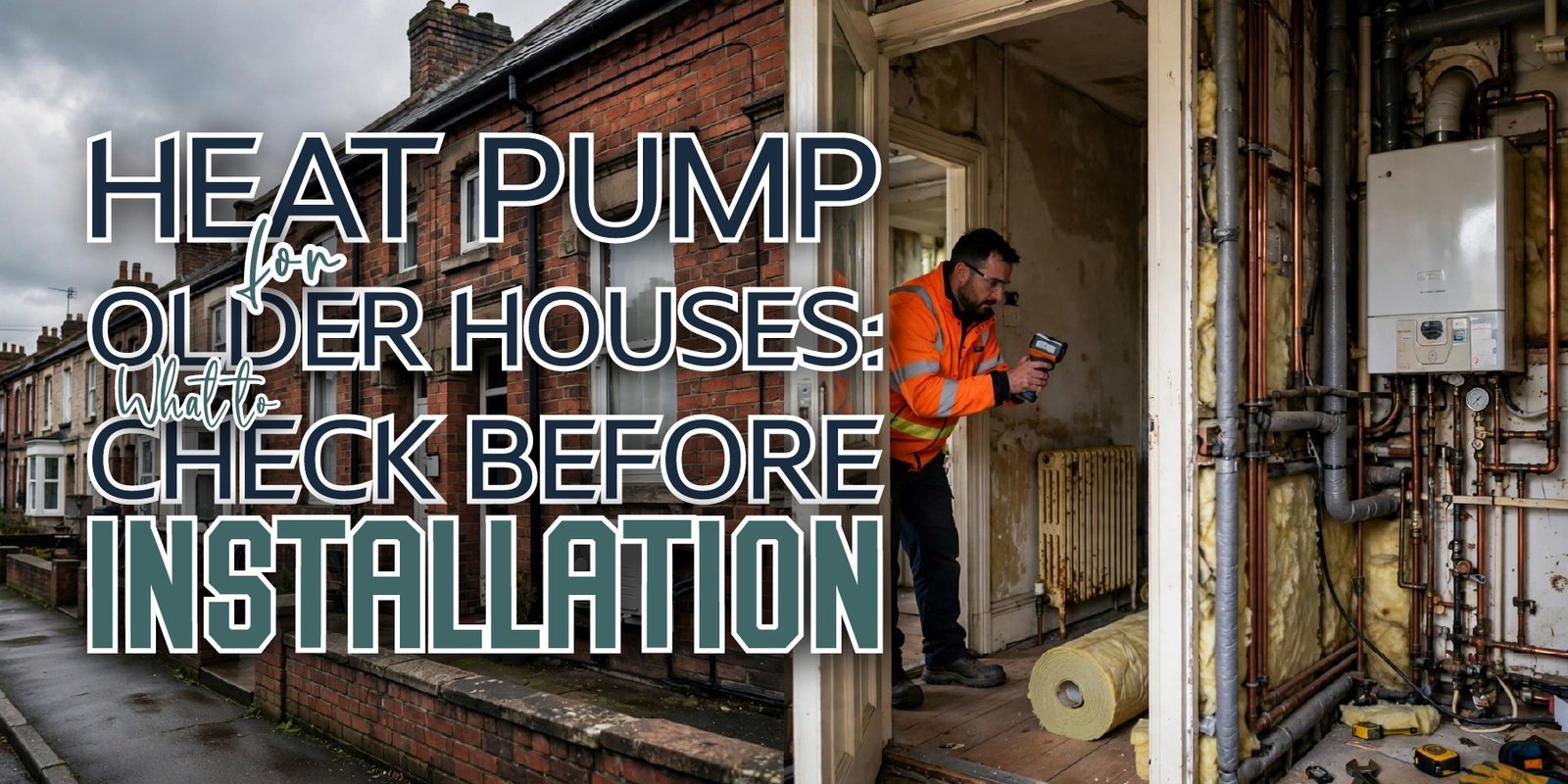
Can an older house work with a heat pump? Potentially, yes. However, the age of the property does not provide enough information to determine whether the system will suit it.
Older UK homes can have different wall constructions, windows, floors, heating systems and levels of insulation. Therefore, the important question is not simply whether the house is old. Instead, homeowners should understand its heat loss, heating demand, existing radiators, available space and installation requirements.
A successful heat pump project starts with assessing the property and heating system before choosing equipment.
Can an Older House Have a Heat Pump?
An older house can potentially use a heat pump, but suitability depends on heat loss, insulation, heating demand, heat emitters, system design and installation requirements. Property age alone is not enough to decide. A proper assessment should establish how much heat each area needs and whether the proposed system can meet that demand.
This distinction is important because “old house” describes age, not necessarily heating performance.
A Victorian terrace, an Edwardian semi-detached property and an older detached house can have very different:
- Wall construction
- Window types
- Floor construction
- Loft insulation
- Heating controls
- Radiators
- Previous alterations
- Heat-loss characteristics
Consequently, there is no universal rule stating that an older house must or must not have a heat pump.
The better approach is to assess the property first and then determine what heating arrangement fits its requirements.
What Makes an Older House Different?
Older homes can contain building features that influence heating demand. However, homeowners should not assume that every older property has the same construction.
An older property may have:
- Solid walls
- Cavity walls
- Suspended timber floors
- High ceilings
- Large rooms
- Older windows
- Older external doors
- Chimneys or fireplaces
- Limited loft insulation
- Traditional radiators
- Older heating controls
Previous renovation work can also change the original characteristics of a property. For example, a homeowner may already have upgraded the windows, insulated the loft or replaced the heating controls.
Therefore, a heat pump assessment should consider the property as it exists today rather than relying solely on its construction date.
Check Heat Loss Before Choosing a Heat Pump
Heat loss is one of the most important factors to understand before choosing a heat pump. It describes the heat a property loses through areas such as walls, windows, doors, roofs, floors and ventilation.
The basic relationship is:
Heat loss → heat demand → system sizing
A property with greater heat loss generally requires more heat to maintain the desired indoor temperature. However, property size alone cannot provide the complete picture.
A useful assessment considers:
- External walls
- Windows
- External doors
- Roof or loft
- Floors
- Room dimensions
- Ventilation
- Desired indoor temperature
- Construction characteristics
For example, two houses with similar floor areas can have different heating requirements because their insulation, windows, room layouts and construction differ.
That is why homeowners should ask how the proposed heat pump system size was calculated rather than choosing equipment simply because it appears suitable for the property’s overall size.
Insulation and Heating: What Should You Check First?
The relationship between insulation and heating matters because insulation can affect how much heat a property needs. However, homeowners should assess construction, condition and moisture behaviour before choosing insulation measures.
Potential areas to review include:
- Loft insulation
- Wall insulation
- Floor insulation
- Windows
- Doors
- Draughts
Improving thermal performance can reduce heat demand in some properties. However, that does not mean every older house needs extensive insulation work before installing a heat pump.
The appropriate approach depends on the existing building fabric and its condition.
For example, the right wall-insulation approach can depend on wall construction and moisture behaviour. Similarly, improving draught control should not mean removing ventilation that the property requires.
Therefore, insulation decisions should form part of the wider heating assessment rather than becoming a separate decision based on age alone.
Will Existing Radiators Work With a Heat Pump?
Existing radiators may work with a heat pump in some properties, but their suitability depends on their heat output, the room’s heat demand, operating temperature and overall system design. Homeowners should therefore ask for existing radiators to be assessed rather than assuming that every radiator must be replaced.
A radiator needs to provide enough heat for its room under the proposed operating conditions.
The assessment may consider:
- Room heat loss
- Radiator output
- Radiator size
- Flow temperature
- Room dimensions
- Insulation
- Heating requirements
An existing radiator may provide sufficient output under one set of operating conditions but not another.
Consequently, radiator suitability should form part of the heat pump design process.
When Might Radiator Upgrades Be Needed?
Radiator upgrades may become relevant where existing emitters cannot provide the required room heat at the proposed system operating temperature.
Several factors influence this decision:
- Heat demand
- Radiator output
- Radiator surface area
- Flow temperature
- Room size
- Insulation
- Heating requirements
A larger or higher-output radiator can sometimes provide the required heat while allowing the system to operate at a lower temperature.
However, that does not mean every older property needs new radiators. Some existing emitters may already provide sufficient output.
The correct decision comes from comparing the room’s heat requirement with the output available from its existing radiator under the proposed operating conditions.
Therefore, ask the installer to identify which radiator upgrades, if any, are actually required rather than accepting a blanket replacement recommendation.
Flow Temperature and Older Houses
Flow temperature affects how much heat an emitter can deliver and can influence how efficiently a heat pump operates. Lower flow temperatures can support efficient operation when the property and heat emitters can still provide the required heat.
The relationship can be simplified as:
Flow temperature → heat-emitter output → system operation → electricity consumption
A radiator’s ability to heat a room depends partly on the temperature difference between the radiator and the room.
Therefore, changing from one heating system to another can require a different approach to emitter capacity.
There is no single flow temperature that is correct for every older property. The appropriate operating conditions depend on:
- Heat loss
- Radiator output
- Property characteristics
- Outdoor conditions
- Heating requirements
- System design
A good heat pump proposal should explain the assumptions behind the proposed operating temperatures.
What Type of Heating System Upgrade Does an Older House Need?
A heating system upgrade should be considered as a complete system rather than simply replacing one appliance.
Depending on the property, the project may involve:
- A heat pump
- Radiators
- Heating controls
- A hot-water cylinder
- Pipework
- Insulation improvements
- Electrical work
- Equipment positioning
Not every property will require every element.
For example, some homeowners may have suitable radiators and controls already, while others may need changes to accommodate the proposed system.
Similarly, available space can influence where equipment and hot-water components can go.
Therefore, a heat pump installation should be planned around the property rather than treating the equipment as an isolated product.
Heat Pump Sizing for Older Properties
Correct sizing matters because the proposed heat pump should relate to the property’s actual heating demand.
A suitable assessment may consider:
- Room-by-room heat loss
- Property construction
- Insulation
- Windows and doors
- Design conditions
- Heating requirements
- Hot-water demand
- Heat-emitter capacity
The objective is not to choose the largest available system.
An undersized system may struggle to meet the property’s heating requirements under relevant conditions. Conversely, choosing equipment without properly assessing the actual demand can create an inappropriate system design.
Therefore, homeowners should ask the installer to explain how the proposed heat pump capacity relates to the calculated heat demand.
Avoid accepting a recommendation based solely on floor area.
Hot Water and Older Homes
Domestic hot water should form part of the overall heating assessment.
The installer may need to consider:
- Household size
- Hot-water usage
- Cylinder requirements
- Available installation space
- Existing pipework
- System layout
- Desired hot-water arrangements
A heat pump can form part of a system that provides both space heating and domestic hot water, but the requirements for each should be considered separately.
For example, a property may have sufficient space for heating equipment but limited space for the proposed hot-water arrangement.
Therefore, ask for hot-water requirements to appear clearly within the heating proposal.
Electrical and Space Requirements
A heating upgrade can involve more than the heating appliance itself. Before installation, the property may need assessment of equipment locations, electrical requirements, pipework and available internal space.
Consider:
- Outdoor equipment location
- Indoor equipment
- Hot-water cylinder
- Pipework
- Heating controls
- Electrical requirements
- Access for installation and maintenance
The precise requirements depend on the proposed system and property.
Consequently, homeowners should ask the installer to explain where each major component will go and what work the installation involves.
A heat pump quotation should provide enough information for the homeowner to understand the overall installation scope.
What Should You Ask a Heat Pump Installer?
Before agreeing to a heat pump installation, ask questions that reveal how the system has been designed for the property.
- How did you calculate the property’s heat demand?
- What assumptions did you use?
- What system size are you proposing?
- Will the existing radiators work?
- Which radiators require upgrading?
- What flow temperature do you expect?
- How will the system provide hot water?
- What insulation improvements do you recommend?
- What controls are included?
- What electrical work is required?
- Where will the equipment be positioned?
- What is included in the quotation?
- What is excluded?
- What warranty applies?
- What maintenance does the system require?
Additionally, ask the installer to explain any recommendations that significantly change the project scope.
A useful heat pump quotation should allow you to understand what the installer proposes and why.
How to Compare Heat Pump Quotes for an Older House
Comparing heat pump quotes requires more than looking at the headline installation price.
Review:
| Area | What to Compare |
|---|---|
| Heat-loss assessment | How the heating demand was calculated |
| System size | Proposed capacity and design assumptions |
| Equipment | Main equipment and included components |
| Radiators | Existing emitters and any upgrades |
| Controls | Included control equipment |
| Hot water | Cylinder and associated installation |
| Installation | Labour and installation scope |
| Electrical work | Required work and whether it is included |
| Insulation assumptions | Existing condition and proposed improvements |
| Warranty | What the written terms cover |
| Exclusions | Work or materials not included |
| Aftercare | Maintenance and support information |
Two quotations can have different prices because they describe different systems or scopes.
Therefore, homeowners should compare like for like wherever possible.
The most useful question is not simply, “Which quotation is cheapest?” Instead, ask, “What exactly am I receiving for the quoted price?”
Common Heat Pump Mistakes in Older Houses
Older properties can require more detailed assessment because their construction and previous alterations vary.
Common mistakes include:
1. Choosing equipment before assessing heat loss
System sizing should follow an understanding of the property’s heating demand.
2. Assuming existing radiators will automatically work
Radiator output should be assessed against room heat requirements.
3. Assuming every old house needs complete insulation replacement
Existing insulation and construction should be assessed first.
4. Ignoring ventilation
Improving airtightness or insulation does not remove the need to consider appropriate ventilation.
5. Choosing a system based only on property size
Floor area alone does not describe the property’s complete heating requirement.
6. Comparing quotes only by headline price
Different equipment, labour and project scopes can produce different totals.
7. Ignoring hot-water requirements
Domestic hot water adds another part to the overall system design.
8. Forgetting electrical requirements
The installation may require electrical considerations that should appear within the project scope.
9. Not checking equipment placement
Outdoor and indoor components need suitable locations.
10. Failing to ask what the quotation excludes
An apparently comprehensive quotation may not include every element a homeowner expects.
Heat Pump for Older Houses: Installation Checklist
Use this checklist before proceeding with a heat pump project:
☐ Property construction assessed
☐ Heat-loss assessment completed
☐ Existing insulation reviewed
☐ Windows and doors considered
☐ Existing radiators assessed
☐ Radiator upgrades identified where needed
☐ Flow temperature discussed
☐ Heat pump size explained
☐ Hot-water requirements assessed
☐ Controls included
☐ Electrical requirements checked
☐ Equipment location considered
☐ Pipework requirements discussed
☐ Quotation scope reviewed
☐ Exclusions checked
☐ Warranty information reviewed
☐ Maintenance requirements discussed
Property Factors That Matter for a Heat Pump
| Property Factor | Why It Matters for a Heat Pump | What to Check |
|---|---|---|
| Insulation | Affects heat loss and heat demand | Existing insulation and improvement options |
| Windows | Can contribute to heat loss | Glazing, frames and condition |
| Radiators | Must deliver required room heat | Output and operating temperature |
| Room size | Influences heat demand | Room-by-room assessment |
| Wall construction | Can affect heat loss and insulation choices | Property construction |
| Heating controls | Influence system operation | Control strategy and compatibility |
| Hot water | Adds another heating requirement | Cylinder and household demand |
| Available space | Affects equipment placement | Indoor and outdoor locations |
These factors are connected. For example, insulation can affect heat demand, while heat demand influences system sizing. Radiator output can then affect whether rooms can receive the required heat at the proposed operating conditions.
Planning a Heating Upgrade for an Older Property
A heating upgrade becomes easier to compare when homeowners define the property’s requirements before requesting proposals.
Consider:
- Heat demand
- Insulation
- Existing radiators
- Heating controls
- Hot water
- Equipment
- Installation scope
- Electrical requirements
- Equipment positioning
- Warranty and aftercare
Before choosing an installer, it is also useful to review home improvement installer checks. This can help homeowners think about quotation scope, installer information, exclusions and questions to raise before work begins.
The objective is not to select an installer based on one feature. Instead, compare the complete proposal and the assumptions behind it.
Coordinating a Heating Upgrade With Other Renovation Work
Older properties often undergo several improvements at the same time. A heating project may therefore sit alongside bathroom, insulation, electrical or general refurbishment work.
Planning the sequence can help avoid unnecessary disruption.
For example, work involving plumbing, walls or floors may affect another renovation project. If a bathroom is also being redesigned, homeowners may want to compare bathroom renovation quotes while considering how the wider project will be coordinated.
The bathroom element should remain separate from the heating assessment. However, defining both projects clearly can make it easier to understand which work happens first and which installers need access to the property.
How to Assess a Heat Pump Proposal
A useful proposal should explain more than the equipment name.
Look for information about:
- Property heat demand
- Proposed system capacity
- Heat emitters
- Flow temperature
- Hot water
- Controls
- Installation work
- Electrical requirements
- Equipment locations
- Insulation assumptions
- Warranty
- Exclusions
- Aftercare
Ask questions where information appears unclear.
For example, if one proposal recommends radiator upgrades and another does not, ask both installers to explain the assumptions behind their recommendations.
That comparison can reveal differences in design rather than simply differences in price.
What Does a Good Installation Assessment Look Like?
A good assessment should relate the proposed heat pump to the individual property.
It should consider the building, heating requirements and practical installation conditions rather than relying on a generic recommendation.
Homeowners can ask:
- Was heat loss assessed?
- Were rooms considered individually?
- Were existing radiators reviewed?
- Was hot-water demand considered?
- Were controls included?
- Was equipment placement assessed?
- Were electrical requirements discussed?
- Were exclusions clearly identified?
The exact assessment process can vary according to the project.
However, the central principle remains the same: understand the property’s requirements before choosing the equipment.
Is Insulation Always Required Before a Heat Pump?
Not necessarily. Some older homes may already have suitable insulation, while others may benefit from specific improvements. The appropriate approach depends on construction, condition, heat loss, moisture behaviour and the proposed heating design.
Therefore, homeowners should avoid treating insulation as an automatic prerequisite for every heat pump installation.
Instead, ask the installer to explain:
- Existing heat loss
- Existing insulation
- Recommended improvements
- Expected effect on system design
- Whether the proposal depends on those improvements
This makes the relationship between insulation and heating clearer.
What About Older Windows?
Older windows do not automatically prevent a heat pump installation.
However, windows can contribute to heat loss, and their condition may affect the property’s heating demand.
Consider:
- Glazing
- Frames
- Seals
- Draughts
- Condition
- Existing thermal performance
If a window problem is causing a significant draught, repair may be worth investigating before replacement.
Similarly, if windows are already performing adequately, replacing them solely because the house is old may not be necessary.
The correct decision depends on the property’s condition and the wider improvement objectives.
Can a Heat Pump Work With High Ceilings and Large Rooms?
It can potentially work in properties with high ceilings or larger rooms, but those characteristics can affect heat demand.
Room dimensions form part of the assessment because the amount of space that needs heating influences the required heat output.
However, room volume is only one consideration. Windows, walls, insulation, ventilation and desired indoor temperatures also influence heat loss.
Therefore, homeowners should rely on a property-specific heat-loss assessment rather than assuming that large rooms automatically rule out a heat pump.
Compare Heating Upgrade Options for Your Home
Choosing a heat pump for an older property starts with understanding the building rather than choosing equipment first.
Before making a decision, compare:
- Heat-loss assumptions
- System sizing
- Insulation requirements
- Existing radiator capacity
- Potential radiator upgrades
- Flow temperature
- Controls
- Hot-water arrangements
- Electrical requirements
- Equipment placement
- Installation scope
- Warranty information
- Exclusions
- Aftercare
Once the requirements are clearer, homeowners can compare heating upgrade options and explore available project routes.
The key is to compare complete heating proposals rather than judging a heat pump installation by equipment price alone.
Can an older house have a heat pump?
Yes, an older house can potentially use a heat pump. However, property age alone does not determine suitability. The assessment should consider heat loss, insulation, radiators, heating demand, system sizing, hot water and installation requirements. Different older properties can have very different construction and heating characteristics, so the system should match the individual building.
Does an old house need better insulation before installing a heat pump?
Not necessarily. Some older properties may already have adequate insulation, while others may benefit from targeted improvements. The decision depends on construction, existing insulation, heat loss, moisture behaviour and system design. Homeowners should ask the installer to explain which insulation measures they consider necessary and how those measures affect the proposed heating system.
Will existing radiators work with a heat pump?
Existing radiators may work with a heat pump if they can provide sufficient heat for their rooms under the proposed operating conditions. Their suitability depends on radiator output, room heat demand, operating temperature and insulation. Therefore, homeowners should request an assessment rather than automatically replacing every radiator.
When are radiator upgrades needed?
Radiator upgrades may be appropriate when existing emitters cannot provide the required room heat at the proposed system operating temperature. The installer can compare radiator output with room heat demand and assess whether larger or higher-output emitters are necessary. Some properties may require upgrades in selected rooms rather than throughout the entire house.
How is heat pump sizing calculated for an older property?
Sizing should relate to the property’s actual heating demand rather than floor area alone. An assessment can consider room dimensions, heat loss through walls and windows, insulation, doors, floors, ventilation and relevant design conditions. Hot-water requirements and the proposed heating system also need consideration when developing the overall design.
What should I ask a heat pump installer?
Ask how the installer calculated heat demand, what system size they propose, whether existing radiators are suitable, what flow temperature they expect and how hot water will be provided. Also ask about controls, electrical work, equipment placement, quotation exclusions, warranty terms and maintenance requirements.
What should I compare in heat pump quotations?
Compare the complete system rather than only the headline price. Check heat-loss calculations, equipment, system size, radiators, controls, hot water, installation work, electrical requirements, insulation assumptions, warranties, exclusions and aftercare. If quotations make different recommendations, ask the installers to explain the assumptions behind those differences.
Can a heat pump work in a house with older windows?
Potentially, yes. Older windows do not automatically prevent a heat pump installation. However, windows can contribute to heat loss, so their condition, glazing, frames and seals may form part of the property’s heating assessment. Depending on the actual problem, repair, draught reduction or replacement may be considered.
Explore Heat Pump Options for Your Property
A heat pump can potentially form part of a heating upgrade in an older UK property, but the right approach depends on the individual building.
Before proceeding, homeowners should understand:
- Property heat loss
- Insulation
- Existing radiator capacity
- Heating demand
- Flow temperature
- Hot-water requirements
- Controls
- Electrical requirements
- Equipment location
- Installation scope
Once these requirements are clearer, you can compare heating upgrade options and assess different project proposals.
The most useful starting point is simple: assess the property first, understand the heating demand, then compare complete system proposals.