
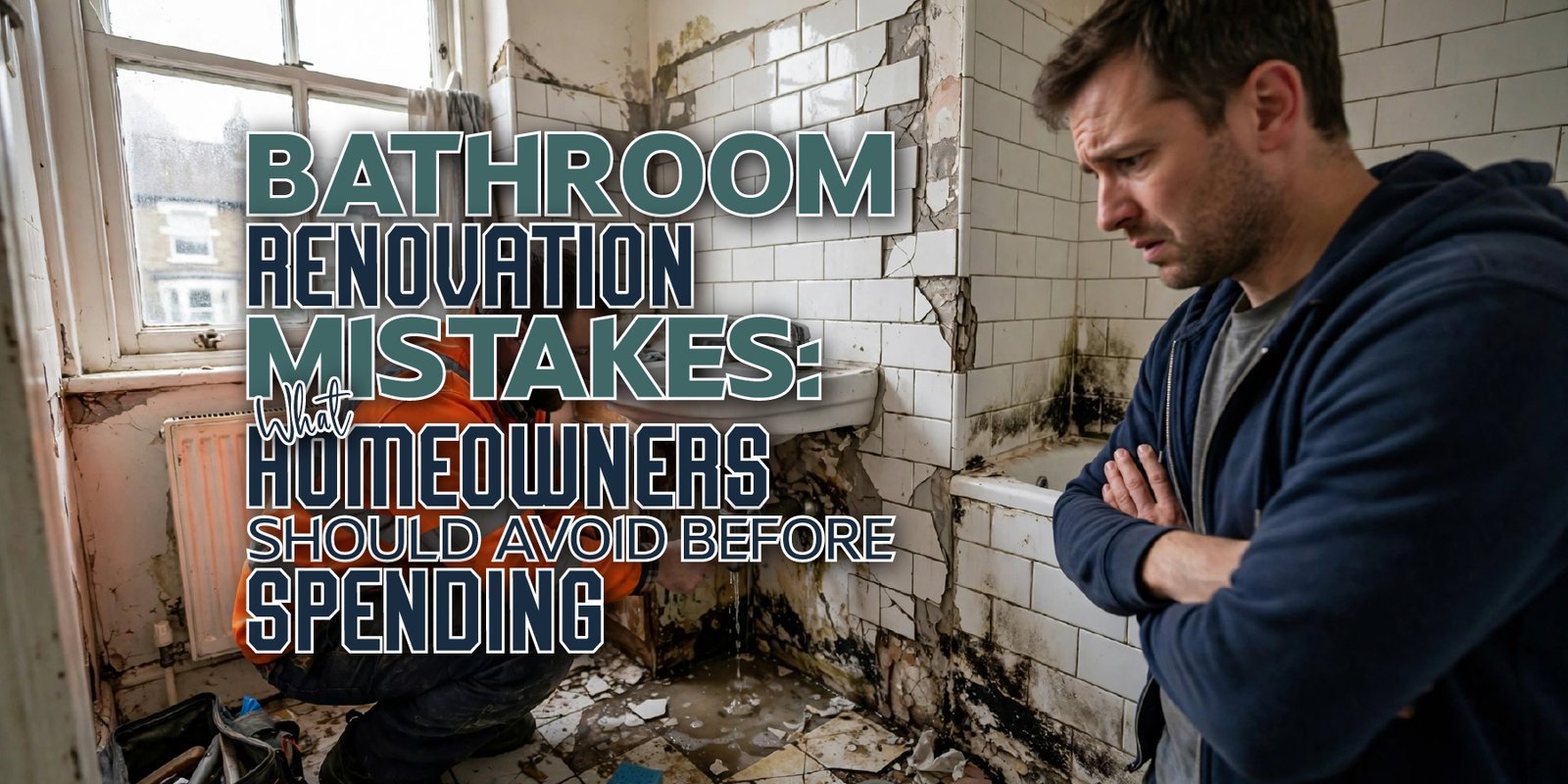
A successful bathroom renovation starts long before the first tile is removed. Many avoidable problems come from unclear project scopes, inaccurate measurements, incomplete quotations, overlooked plumbing, unsuitable products or unrealistic timescales.
For UK homeowners, careful preparation can make the difference between a straightforward project and one that becomes difficult to manage. Therefore, the aim should not simply be to choose attractive fixtures. Instead, understand the room, define the work, check the practical requirements and compare installers before committing money.
What Are the Most Common Bathroom Renovation Mistakes?
The most common bathroom renovation mistakes include poor planning, inaccurate measurements, overlooking plumbing and ventilation, comparing incomplete quotations, choosing products too early and failing to check the installer. Homeowners can reduce avoidable problems by defining the project scope, checking the room carefully and comparing quotations on a like-for-like basis.
A bathroom renovation involves several connected decisions. For example, changing the position of a toilet can affect drainage, while changing the shower can affect plumbing, electrical work and ventilation.
Similarly, choosing a larger vanity unit can reduce available circulation space.
The major areas to consider include:
- Planning and measurements
- Layout
- Plumbing and drainage
- Ventilation
- Electrical work
- Fixtures and materials
- Storage
- Installer selection
- Quotation scope
- Budget
- Timescale
- Changes during the project
The earlier you identify these issues, the easier it becomes to compare proposals and make informed decisions.
Bathroom Renovation Planning: What Should You Decide First?
Good renovation planning starts with the existing bathroom rather than individual products. First identify what does not work, then measure the room, establish the desired layout, review plumbing and electrical requirements, choose suitable fixtures and materials, define the budget and finally compare installers and quotations.
Before beginning a bathroom renovation, write down the project’s objectives.
For example, you may want to:
- Replace an outdated suite
- Improve storage
- Replace a bath with a shower
- Improve lighting
- Change the layout
- Address damaged finishes
- Improve ventilation
- Make the room easier to clean
- Create more usable space
Next, separate essential work from optional improvements.
This distinction can help when comparing quotations. An installer who includes extensive additional work may produce a higher quotation than one who has priced only the basic replacement.
Therefore, define exactly what you want each quotation to cover.
Mistake 1: Choosing Bathroom Products Before Measuring
One of the easiest mistakes during a bathroom renovation is buying products before confirming that they fit the room.
This can affect:
- Toilets
- Baths
- Shower enclosures
- Basins
- Vanity units
- Cabinets
- Heated towel rails
A product can look compact on a website but still create difficulties once you consider the surrounding space.
Before ordering anything, check:
- Room length and width
- Ceiling height where relevant
- Door swing
- Window position
- Existing pipework
- Waste locations
- Wall positions
- Available circulation space
- Product dimensions
Also consider how the door opens and how people move around the room.
For instance, a larger vanity may provide useful storage but leave less room around the basin. A shower enclosure may fit within the room but create an awkward entrance.
Therefore, finalise the layout and measurements before committing to major fixtures.
Mistake 2: Ignoring Plumbing and Drainage
Plumbing can significantly influence the scope of a bathroom renovation. Moving a fixture from one location to another may require more work than replacing it in its existing position.
Potential considerations include:
- Water supply routes
- Waste pipes
- Soil pipe position
- Shower pipework
- Basin connections
- Floor access
- Wall access
- Drainage routes
Moving a toilet can be particularly important because its waste connection needs suitable routing.
Likewise, moving a shower may involve changes behind walls or beneath floors.
That does not mean homeowners should never change their bathroom layout. Rather, they should understand the practical implications before approving the design.
Ask the installer to explain which plumbing changes the proposed layout requires and whether those changes are included in the quotation.
Mistake 3: Forgetting Bathroom Ventilation
Ventilation deserves attention during every bathroom renovation, particularly because bathrooms regularly produce moisture.
Showers and baths introduce water vapour into the room. Without appropriate ventilation, moisture can contribute to condensation and potentially create conditions that encourage mould.
Consider:
- Existing airflow
- Windows
- Extractor fans
- Ventilation routes
- Moisture levels
- Room layout
Ventilation requirements can vary according to the property and project. Therefore, do not treat an extractor fan as an isolated product decision.
Instead, ask the installer how the proposed bathroom layout and ventilation arrangement will manage moisture.
Homeowners should also avoid blocking or removing ventilation without understanding why it exists. Improving the appearance of a room should not compromise its ability to manage moisture.
Mistake 4: Comparing Bathroom Quotes Only by Price
Price is important, but it should not become the only measure during a bathroom renovation.
Two quotations can differ because they include different levels of labour, materials or preparation.
Compare whether each quotation covers:
- Labour
- Bathroom fixtures
- Materials
- Plumbing
- Electrical work
- Ventilation
- Tiling
- Flooring
- Preparation
- Removal
- Waste disposal
- Finishing
- Project management
- Exclusions
- VAT where applicable
A lower headline figure may not represent a lower overall project cost if important work sits outside the quoted scope.
Therefore, homeowners should compare equivalent specifications wherever possible.
Before choosing an installer, it can be useful to compare bathroom renovation quotes and review exactly what each proposal includes.
Bathroom Quote Checklist: What Should a Quote Include?
A useful bathroom quote checklist should cover the complete agreed scope rather than simply providing one total figure. Homeowners should check labour, fixtures, materials, plumbing, electrical work, ventilation, tiling, flooring, preparation, waste disposal, timescale, payment terms, exclusions and how changes will be handled.
Use this checklist when reviewing quotations:
☐ Labour
☐ Bathroom fixtures
☐ Materials
☐ Plumbing
☐ Electrical work
☐ Ventilation
☐ Tiling
☐ Flooring
☐ Preparation
☐ Removal of existing fixtures
☐ Waste disposal
☐ Decorating and finishing
☐ Expected timescale
☐ Payment schedule
☐ Exclusions
☐ Variations or changes
☐ VAT where applicable
☐ Warranty or guarantee information
The exact contents will depend on the project.
For that reason, ask questions whenever an item appears unclear rather than assuming it forms part of the quotation.
Mistake 5: Choosing an Installer Without Checking the Details
Choosing an installer is one of the most important decisions in a bathroom renovation.
Before hiring someone, consider:
- Relevant experience
- Previous work
- Written quotation
- Project scope
- Communication
- Payment terms
- Proposed programme
- Insurance where applicable
- Guarantees or warranties offered
- References where available
A professional-looking quotation does not automatically tell you everything about how the project will be managed.
Ask who will complete the different elements of the work. If several trades are involved, establish who coordinates them.
Additionally, clarify how the installer handles unexpected issues and requested changes.
For a wider checklist covering the information worth checking before appointing a contractor, homeowners can review these home improvement installer checks.
The objective is not to select an installer based on one factor. Instead, assess the complete proposal and the terms surrounding the work.
Mistake 6: Underestimating Bathroom Fitting Problems
Bathroom fitting problems often begin with decisions made before installation starts.
Common examples include:
- Incorrect measurements
- Product conflicts
- Plumbing conflicts
- Drainage problems
- Poor preparation
- Inadequate access
- Incomplete finishing
- Unexpected material requirements
For example, a chosen basin may fit against the wall but conflict with a nearby door or cabinet.
Similarly, a shower may fit within the available area but leave insufficient practical access.
Good planning cannot eliminate every unexpected issue. However, it can identify many foreseeable problems before work begins.
Therefore, review the proposed layout carefully and ask the installer to identify potential conflicts before ordering products.
Mistake 7: Forgetting Electrical and Lighting Requirements
Electrical work should form part of the planning process rather than becoming an afterthought.
Depending on the project, homeowners may need to consider:
- General lighting
- Mirror lighting
- Extractor fans
- Heated towel rails
- Electric showers
- Permitted sockets
- Switches
- Other electrical equipment
Bathroom electrical work has specific safety considerations. Therefore, homeowners should use an appropriately qualified professional for electrical work where required and avoid treating electrical installation as a DIY task.
During a bathroom renovation, decide where lighting and electrical equipment should go before walls and finishes are completed.
This is particularly important if the new layout differs significantly from the existing arrangement.
Mistake 8: Ignoring Storage and Everyday Use
A bathroom can look impressive while still being inconvenient to use.
Storage should therefore form part of the design from the beginning.
Think about where you will keep:
- Toiletries
- Towels
- Cleaning products
- Toilet rolls
- Personal-care items
- Family supplies
Potential options include:
- Vanity storage
- Mirrored cabinets
- Wall-mounted cupboards
- Shelving
- Recessed storage where appropriate
However, adding more furniture is not always the answer.
Too much storage can reduce available floor space and make a compact room feel crowded.
As a result, good bathroom design balances storage capacity with circulation and everyday usability.
Mistake 9: Setting an Unrealistic Bathroom Renovation Timescale
A bathroom renovation can involve several stages, so homeowners should avoid assuming that every project follows the same programme.
Potential stages include:
- Removal
- Preparation
- Plumbing
- Electrical work
- Waterproofing where required
- Tiling
- Flooring
- Fixture installation
- Finishing
- Final checks
The programme can also depend on product availability, access, the number of trades involved and unexpected issues discovered during removal.
Therefore, ask the installer for a realistic project programme based on the agreed scope.
Do not rely on a generic number of days found online.
Mistake 10: Changing the Scope Halfway Through
Late changes can complicate a bathroom renovation.
For example, changing tile selection after ordering materials may affect procurement. Moving a shower after plumbing work has started can affect labour and installation sequence.
Other examples include:
- Changing vanity dimensions
- Adding new lighting
- Moving a toilet
- Changing flooring
- Adding storage
- Upgrading fixtures
Changes are sometimes necessary. However, homeowners should understand their potential effect on cost, materials and programme before approving them.
Where possible, finalise major design decisions before work begins.
Older Bathrooms: What Should You Check Before Renovating?
Older bathrooms may require additional investigation, although homeowners should not assume that every older property has hidden problems.
Potential areas to review include:
- Ageing pipework
- Previous repairs
- Uneven floors
- Wall condition
- Damp
- Ventilation
- Existing electrical installation
- Concealed plumbing
- Previous alterations
During a bathroom renovation, removing old fixtures can reveal conditions that were not visible beforehand.
Therefore, ask the installer how they handle unexpected findings.
A clear quotation should also explain how additional work or variations will be agreed.
Bathroom Renovation Budget: What Costs Are Easy to Miss?
A renovation budget can overlook work that does not appear in the final visual design.
Potential categories include:
- Preparation
- Removal
- Waste disposal
- Plumbing changes
- Electrical work
- Ventilation
- Waterproofing
- Tiling
- Flooring
- Wall preparation
- Finishing
- Replacement materials
- Unexpected repairs
Do not assume that every quotation includes these items.
Instead, check the scope line by line.
For example, one installer may include removal and waste disposal while another may exclude them. Similarly, one quotation may include wall preparation while another may assume the walls are already suitable for finishing.
The more clearly you define the scope, the easier it becomes to compare the quotations.
How to Compare Bathroom Renovation Quotes Properly
A useful comparison should look beyond the final total.
Follow this process:
1. Compare the scope
Check whether both installers are quoting for the same work.
2. Compare labour
Understand which trades and tasks the labour allowance covers.
3. Compare materials
Check what materials are included and whether product specifications differ.
4. Compare fixtures
Confirm that toilets, basins, baths, showers, cabinets and other selected items appear in the quotation.
5. Compare plumbing
Check whether proposed pipework and drainage changes are included.
6. Compare electrical work
Confirm lighting, extractor fans and other relevant electrical work.
7. Compare ventilation
Establish what ventilation work forms part of the proposal.
8. Compare tiling and flooring
Check preparation, materials, installation and finishing.
9. Compare waste removal
Confirm who removes existing fixtures and construction waste.
10. Compare timescales
Check the proposed programme and what could cause changes.
11. Compare payment terms
Understand when payments become due.
12. Compare variations
Ask how additional work or requested changes will be priced and approved.
13. Compare warranty information
Check what warranties or guarantees the installer actually offers.
14. Check exclusions
Make a list of anything not included.
A like-for-like comparison is much more useful than simply placing two headline prices next to each other.
Planning Your Bathroom Renovation With More Confidence
A well-defined project gives homeowners a clearer basis for comparing installers.
Before requesting or accepting quotations, prepare:
- Measurements
- Desired layout
- Fixture requirements
- Material preferences
- Storage requirements
- Plumbing changes
- Electrical requirements
- Ventilation requirements
- Finishing requirements
- Expected timescale
Then ask each installer to quote against the same basic scope.
Additionally, review home improvement installer checks before making a final appointment.
This approach does not guarantee that every project will run without issues. However, it can make differences between proposals easier to identify.
Bathroom Renovation Mistakes Checklist
Use this checklist before work begins:
☐ Measure the bathroom
☐ Confirm the desired layout
☐ Check door and window positions
☐ Review existing plumbing
☐ Review drainage
☐ Consider ventilation
☐ Check electrical requirements
☐ Plan lighting
☐ Choose fixtures based on confirmed measurements
☐ Plan storage
☐ Decide materials
☐ Define the project scope
☐ Request written quotations
☐ Compare quotations on a like-for-like basis
☐ Check installer details
☐ Review exclusions
☐ Confirm payment terms
☐ Discuss the expected timescale
☐ Clarify how changes will be handled
☐ Review warranty or guarantee information
Common Mistakes at a Glance
| Potential Mistake | Why It Can Cause Problems | What Homeowners Can Check |
|---|---|---|
| Poor measurements | Products may not fit the intended space | Measure the room and check product dimensions |
| Incomplete quote | Extra costs may appear later | Compare inclusions and exclusions |
| Ignoring plumbing | Layout changes may increase project complexity | Discuss pipework before work starts |
| Poor ventilation planning | Moisture management may become difficult | Discuss ventilation requirements |
| No clear scope | Different installers may quote for different work | Create a written project specification |
| Unrealistic timescale | Delays can affect household routines | Ask for a realistic programme |
| Choosing products too early | Fixtures may conflict with the layout | Finalise measurements and layout first |
| Skipping installer checks | Important project details may be overlooked | Review experience, quotation and terms |
The table highlights an important principle: most decisions connect to another part of the project.
Measurements affect fixtures. Fixtures affect layout. Layout affects plumbing. Plumbing affects labour and programme. Meanwhile, quotation scope affects how different installers can be compared.
What Should Homeowners Check Before Work Starts?
Before a bathroom renovation begins, review the agreed documents and make sure the important decisions are clear.
Check:
- Final layout
- Product specifications
- Measurements
- Plumbing scope
- Electrical scope
- Ventilation
- Materials
- Labour
- Waste removal
- Timescale
- Payment schedule
- Exclusions
- Variation process
- Warranty information
If something remains unclear, ask before work begins.
A short clarification at the planning stage can be easier to manage than a disagreement after installation has started.
What are the most common bathroom renovation mistakes?
The most common bathroom renovation mistakes include poor planning, inaccurate measurements, incomplete quotations, overlooked plumbing, inadequate ventilation planning and insufficient installer checks. Homeowners can reduce avoidable problems by defining the project scope, checking dimensions before ordering products and comparing quotations based on equivalent work rather than headline price alone.
What should I plan before starting a bathroom renovation?
Start by identifying the problems you want to solve, then measure the room and establish the preferred layout. Next, review plumbing, drainage, ventilation and electrical requirements before selecting fixtures and materials. Finally, define the project scope and use the same information when requesting quotations so installers can price comparable work.
What should a bathroom quote include?
A bathroom quote can include labour, fixtures, materials, plumbing, electrical work, ventilation, tiling, flooring, preparation, removal, waste disposal and finishing. However, the exact scope varies between projects and installers. Check the quotation for exclusions, payment terms, variations, timescales and any warranty or guarantee information before agreeing to the work.
How can I compare bathroom renovation quotes?
Compare bathroom renovation quotes on a like-for-like basis. Check whether each proposal covers the same fixtures, materials, labour, plumbing, electrical work, ventilation, tiling, flooring, waste removal and preparation. Then review exclusions, payment terms, variations and timescales. A headline price alone does not explain what work each installer has included.
What causes common bathroom fitting problems?
Bathroom fitting problems can result from inaccurate measurements, unsuitable products, plumbing conflicts, drainage limitations, inadequate preparation or incomplete finishing. Some issues become apparent only when existing fixtures are removed. Careful measurements, a defined layout and a detailed quotation can help identify foreseeable problems before installation begins.
Should I choose bathroom fixtures before hiring an installer?
It is generally better to establish the layout and measurements before committing to major bathroom fixtures. An installer can then assess whether the selected products suit the available space and existing plumbing. You can discuss preferred products early, but avoid purchasing major items until their dimensions, installation requirements and compatibility have been checked.
How long does a bathroom renovation take?
There is no single timescale that applies to every bathroom renovation. The programme can depend on demolition, preparation, plumbing, electrical work, waterproofing, tiling, flooring, fixture installation, product availability and unexpected issues. Ask the installer for a project programme based on the agreed scope rather than relying on a generic duration.
What should I check before choosing a bathroom installer?
Check relevant experience, previous work where available, the written quotation, project scope, payment terms, proposed programme, communication arrangements and any insurance, warranty or guarantee information that applies. Also ask how the installer handles variations and unexpected problems. A detailed comparison can help you understand the differences between proposals before committing to one.
Compare Your Bathroom Renovation Options
Before committing to a bathroom renovation, make sure you understand the project rather than focusing only on the finished appearance.
Review:
- Measurements
- Layout
- Fixtures
- Plumbing
- Drainage
- Electrical requirements
- Ventilation
- Materials
- Storage
- Labour
- Timescale
- Exclusions
- Payment terms
- Variation arrangements
Once the scope is clear, homeowners can compare your home-improvement options and assess which project route fits their requirements.
The aim is not to eliminate every possible complication. Instead, good preparation helps identify questions early, makes quotations easier to compare and gives homeowners a clearer understanding of what they are agreeing to.